AI Dropshipping Sourcing vs. Traditional Agents: What Should Dropshippers Choose?
Finding profitable products is only one part of running a successful dropshipping business. Sellers also need reliable suppliers, competitive purchasing prices, consistent product quality, and a fulfillment process that can handle growing orders.
Traditional sourcing often involves searching supplier marketplaces, comparing quotations, contacting factories, and following up with agents. These manual tasks can take considerable time, especially when sellers manage multiple products.
AI dropshipping sourcing offers another approach. Platforms like TeemDrop use AI-assisted product research and supplier matching to simplify sourcing, while connecting product procurement with quality control and order fulfillment.
But can AI replace a traditional sourcing agent? Understanding the differences in efficiency, cost, supplier management, and fulfillment can help sellers choose the right approach.
Quick Answer: AI Dropshipping Sourcing vs. Traditional Agent
AI dropshipping sourcing uses artificial intelligence to support product research, supplier matching, and cost analysis. Traditional sourcing agents rely more on manual research, supplier relationships, direct communication, and negotiation.
AI is useful for processing large amounts of product information and reducing repetitive tasks, while human agents offer hands-on support for complex purchasing requirements and supplier coordination.
For many sellers, combining AI-powered tools with human expertise provides a practical balance between sourcing efficiency and supply chain control.
What Is AI Dropshipping Sourcing?
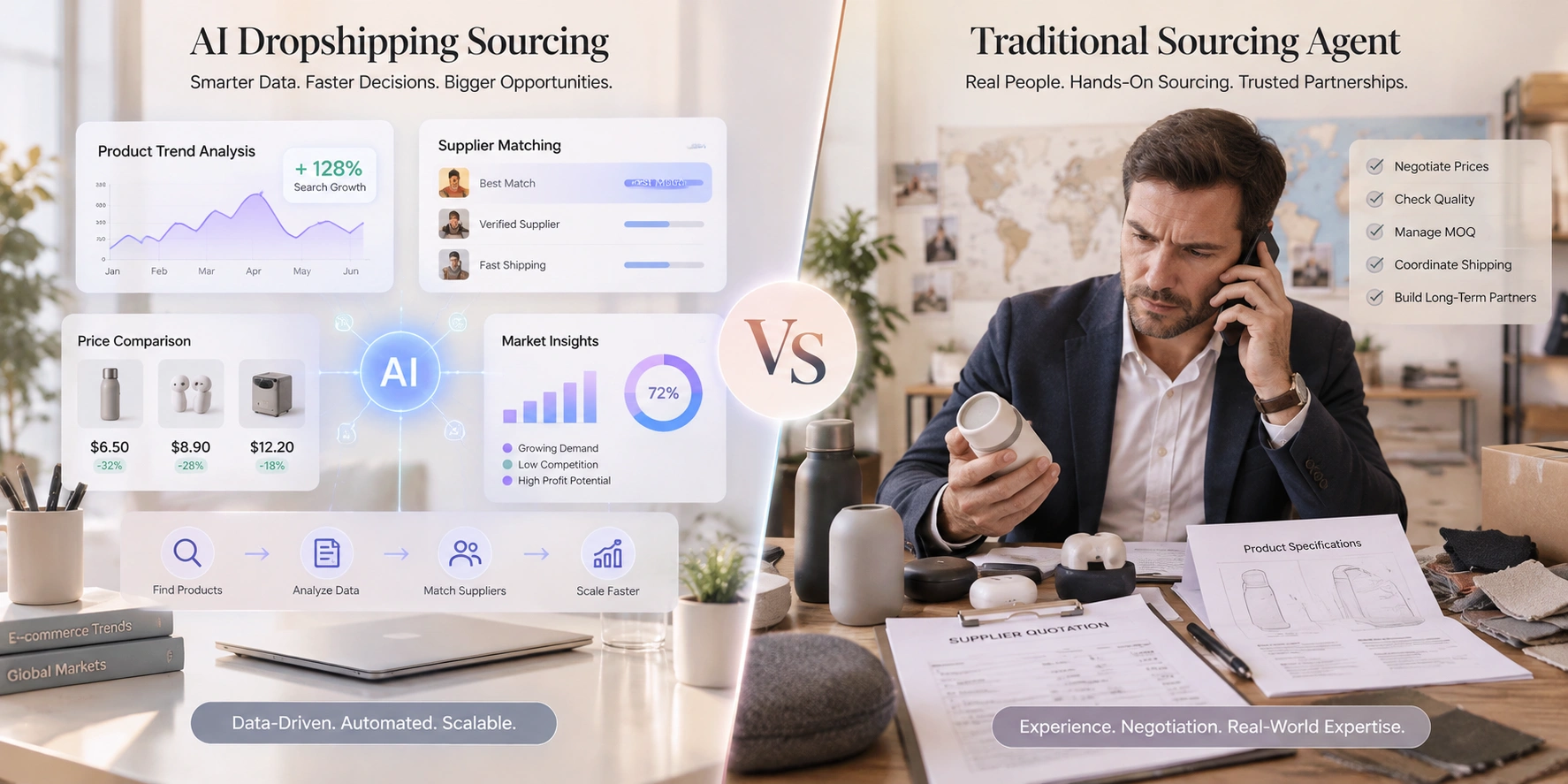
AI dropshipping sourcing uses artificial intelligence to improve how sellers research products, evaluate suppliers, and compare purchasing costs.
Instead of manually reviewing large numbers of product listings, sellers can use AI-powered sourcing tools to organize product information, identify market opportunities, and narrow down potential suppliers.
This approach helps reduce repetitive research and supports more informed sourcing decisions.
How AI-Powered Product Sourcing Works
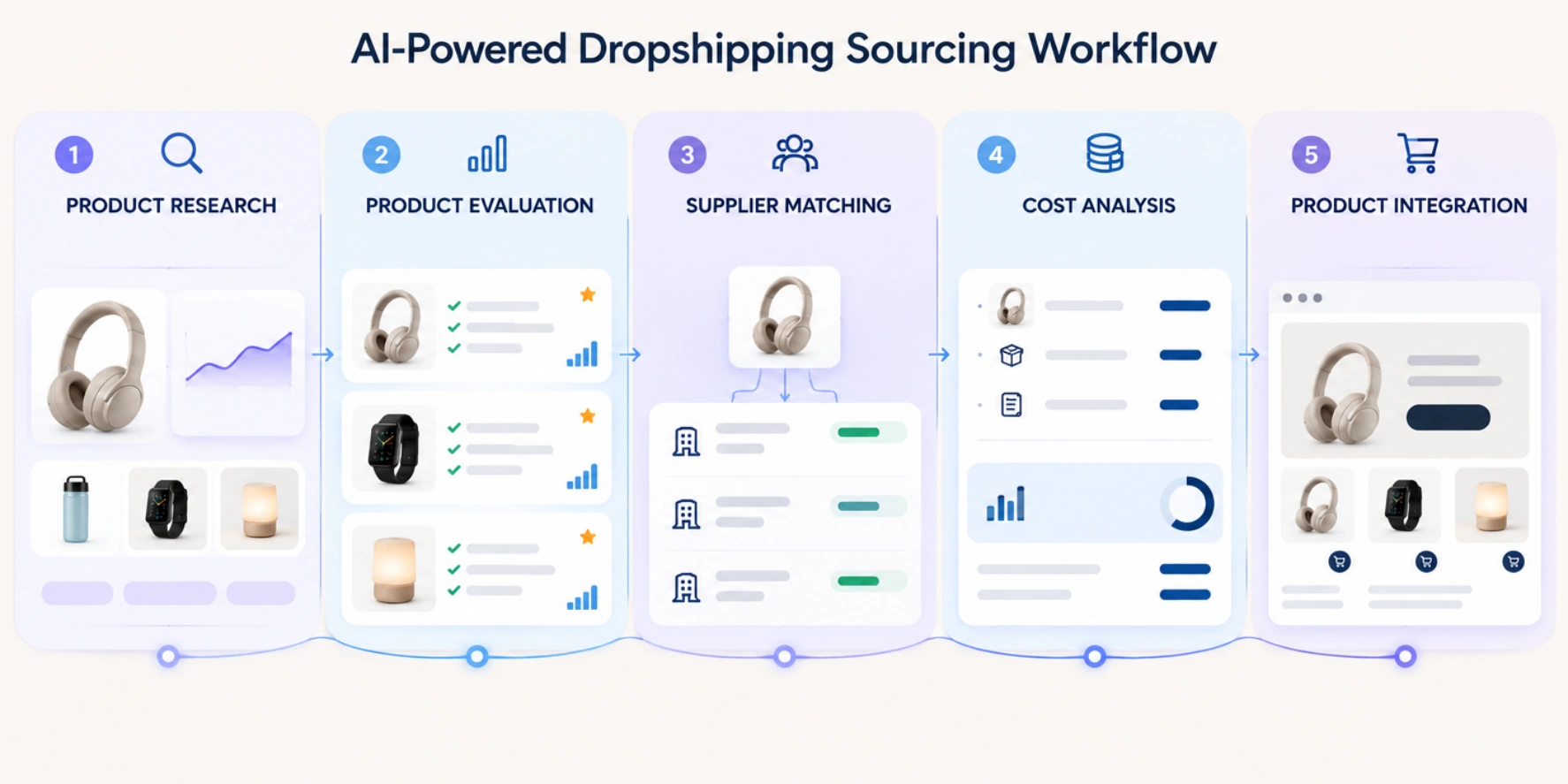
A typical AI-assisted sourcing process includes several steps:
- Product research: Analyze search trends, customer interests, and market demand to identify potential products.
- Product evaluation: Compare prices, product features, competition, and estimated profit margins.
- Supplier matching: Identify potential suppliers based on product requirements and available supplier information.
- Cost analysis: Estimate product costs and other expenses before making purchasing decisions.
- Product integration: Connect selected products with an ecommerce store to simplify listing and management.
AI can process information much faster than manual research in many situations. It can also help sellers organize large amounts of supplier and product data.
However, AI recommendations should not be treated as guaranteed results. Sellers still need to check product samples, confirm supplier details, and evaluate actual market demand before investing.
What Can AI Automate in Sourcing?
AI is particularly useful for tasks that involve repeated searches, comparisons, and data processing.
Depending on the tools and data available, AI can help sellers identify product trends, organize supplier information, compare quotations, and review potential sourcing risks.
IBM explains that AI can help procurement teams organize contract information, improve visibility, identify potential risks, and reduce manual work. It also emphasizes that AI supports rather than replaces human judgment.[1]
These capabilities make AI a useful support tool for dropshipping sellers managing multiple products and supplier relationships.
What Does a Traditional Dropshipping Sourcing Agent Do?
A traditional dropshipping sourcing agent helps ecommerce sellers find suitable products, contact manufacturers, compare quotations, and coordinate purchasing.
Many agents work with Chinese supplier marketplaces such as 1688 and Taobao, along with direct factory networks. Their main strengths are supplier relationships, product knowledge, manual negotiation, and hands-on communication.
However, a sourcing agent's services can differ from those of a full-service dropshipping agent. Some focus only on procurement, while others also support inventory management and individual order fulfillment.[2]
Product Research and Supplier Communication
A traditional sourcing agent usually starts by understanding what the seller wants to purchase.
Their responsibilities may include:
- Searching for products based on specific requirements.
- Contacting manufacturers and suppliers.
- Requesting product quotations and checking minimum order quantities.
- Negotiating prices with suppliers.
- Arranging product samples.
- Communicating special product requirements.
This approach can be valuable when a product has specific materials, dimensions, packaging, or customization requirements.
An experienced agent may also identify alternative suppliers that a seller would not easily find through a standard marketplace search.

Manual Procurement and Order Coordination
Some agents offer additional services such as product inspections, inventory coordination, packaging, and shipping.
However, these services depend on the provider. A sourcing agent may focus only on finding and purchasing products, while a full-service dropshipping agent may also handle warehousing and individual customer orders.
Sellers should check the exact service scope before choosing a sourcing partner.
AI Dropshipping Sourcing vs. Traditional Agent: 6 Key Differences
Both approaches help sellers find products and suppliers, but they use different methods and offer different levels of automation.
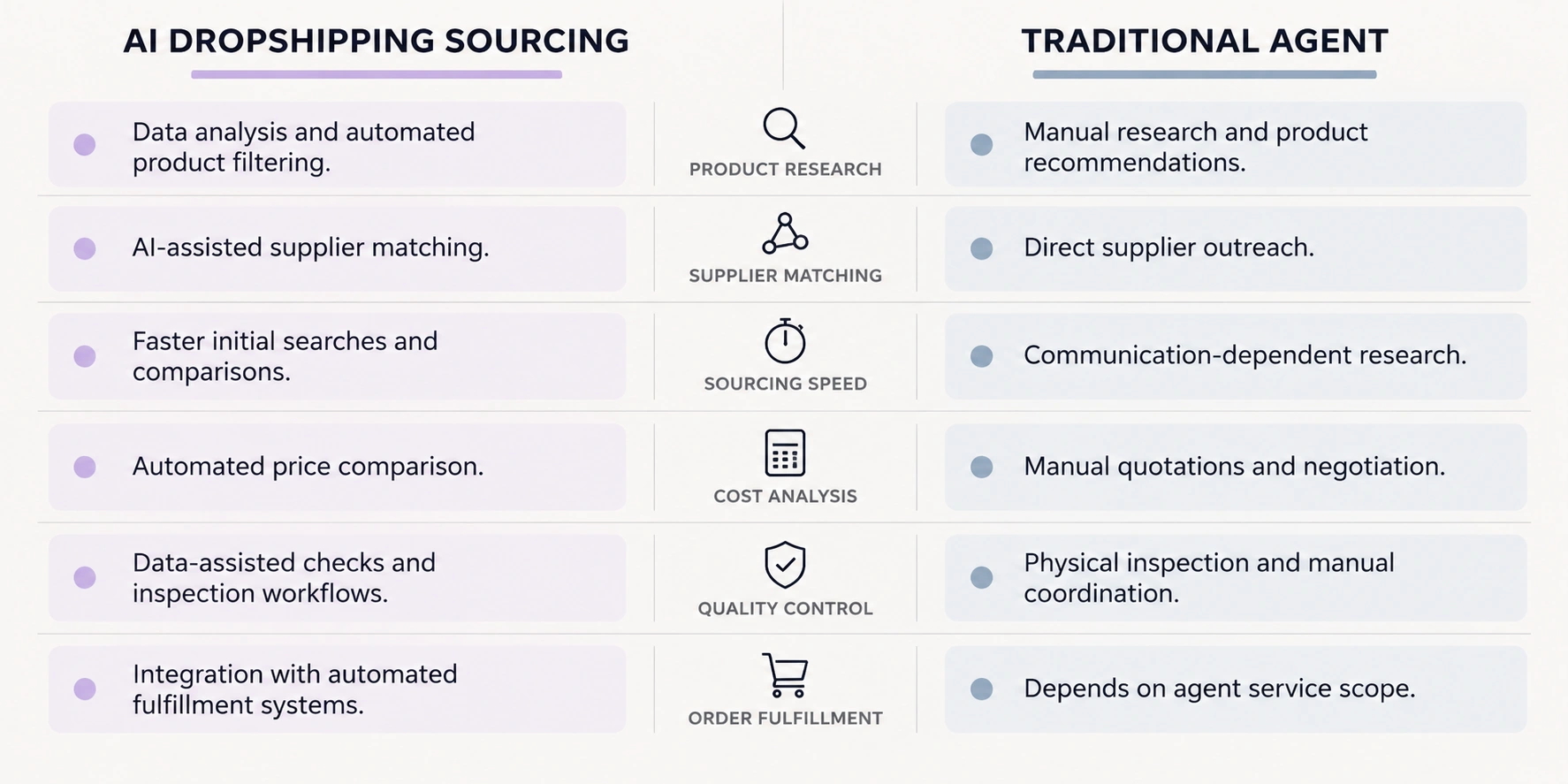
The following comparison highlights the main differences.
| Comparison Factor |
AI Dropshipping Sourcing |
Traditional Agent |
| Product Research |
Data analysis and automated product filtering |
Manual research and recommendations |
| Supplier Matching |
AI-assisted supplier matching |
Direct supplier outreach and selection |
| Sourcing Speed |
Faster initial searches and comparisons |
Depends on communication and research time |
| Cost Analysis |
Automated price comparison and cost estimates |
Manual quotations and negotiation |
| Quality Control |
Data-assisted checks and inspection workflows |
Physical inspection and manual coordination |
| Order Fulfillment |
Can connect with automated fulfillment systems |
Depends on the agent's services |
Neither approach is automatically better in every situation. The difference lies in how sourcing tasks are completed and how much operational support is available.
1. Product Discovery and Market Research
Finding products with real market potential is one of the biggest challenges for dropshipping sellers.
Traditional agents usually rely on supplier catalogs, industry experience, and manual research to recommend products. Reviewing large numbers of listings can take considerable time.
Depending on the available data, AI-powered product sourcing tools can help analyze product trends and market demand signals, allowing sellers to narrow down potential opportunities more efficiently.
Key difference: AI is useful for processing large amounts of product information, while traditional agents can provide recommendations based on direct experience and supplier relationships.
2. Supplier Matching and Verification
Finding a supplier is not the same as finding a reliable supplier.
Traditional agents can contact factories directly, confirm product specifications, request samples, and build long-term supplier relationships.
AI-powered tools can simplify the initial supplier matching process by organizing available supplier information and identifying potential matches based on product requirements.
However, data alone cannot guarantee supplier reliability or consistent product quality. Sellers should still verify supplier details, review samples, and confirm purchasing terms.
Combining AI-assisted supplier selection with human verification provides a more balanced sourcing process.
3. Sourcing Speed and Efficiency
Manual sourcing often involves several rounds of communication:
- Search for a suitable product.
- Contact multiple suppliers.
- Wait for quotations.
- Compare prices and specifications.
- Confirm product availability.
AI can speed up the initial research process by organizing product information and filtering relevant options before sellers contact suppliers.
However, custom products, special materials, and complex purchasing requirements still require direct communication and approval. AI can reduce research time, but it cannot eliminate every step of supplier coordination.
4. Product Cost Analysis and Pricing
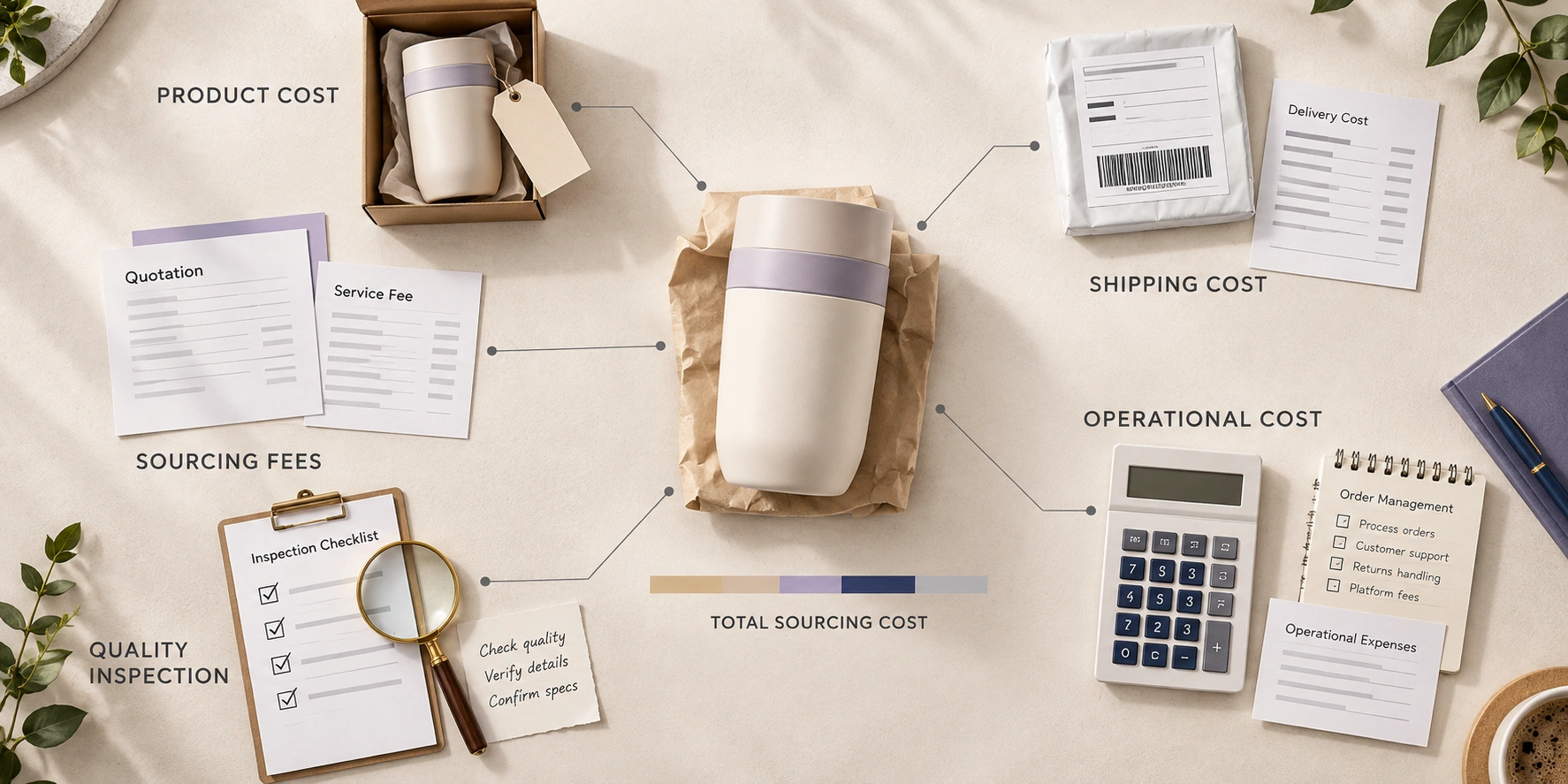
Product price is important, but sellers should consider the total cost of sourcing and fulfilling an order.
Traditional agents usually obtain quotations and negotiate prices based on order volume, product specifications, and supplier relationships. AI-powered tools can help compare available prices and estimate potential profit margins.
Before choosing a supplier, sellers should consider:
- Product purchasing costs.
- Shipping and fulfillment fees.
- Packaging expenses.
- Applicable customs duties and taxes.
- Potential defect and return costs.
AI makes cost comparisons easier, while experienced agents may secure better terms through direct negotiation. The final decision should be based on the total cost rather than the lowest product price.
Comparing the full cost of sourcing and delivery also helps sellers evaluate different dropshipping fulfillment pricing options before choosing a supplier.
5. Quality Control and Risk Management
Product quality directly affects customer satisfaction, store reviews, and return rates.
Traditional agents can arrange sample checks, communicate product requirements to factories, and coordinate physical inspections. AI can support the process by organizing supplier information and identifying potential quality risks.
However, data analysis cannot replace physical inspections. Effective dropshipping quality control should cover product appearance, specifications, functionality, packaging, and order accuracy.
TeemDrop supports this process through pre-shipment inspections, photo and video confirmation, defect detection, and inspection reports. Sellers can review inspection results before products are dispatched.
Technology improves visibility, while physical checks help verify the actual condition of products.
6. Order Fulfillment and Scalability
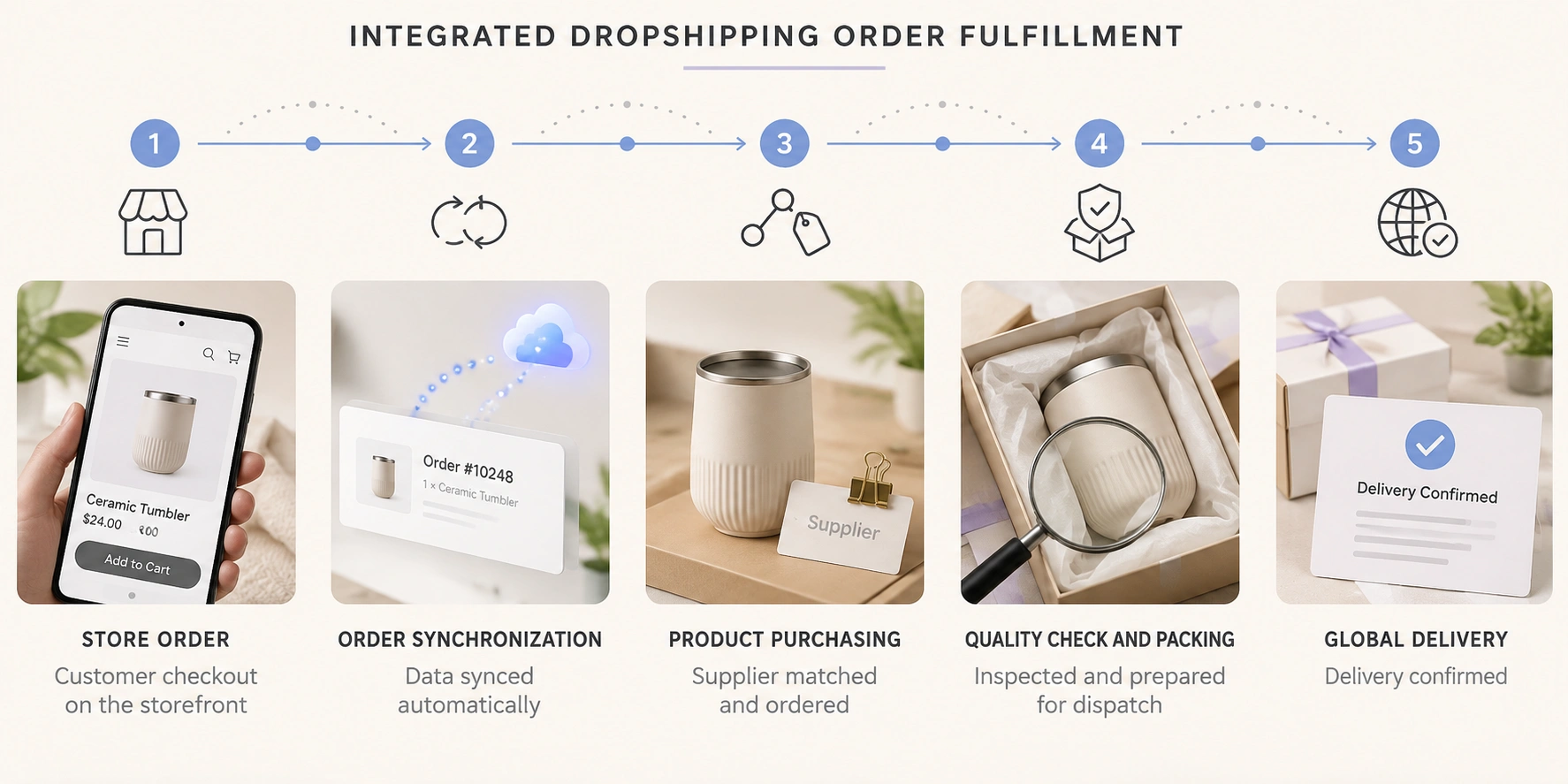
Product sourcing is only the first step in a dropshipping operation. Once customers place orders, sellers also need to manage purchasing, inventory, packaging, shipping, and tracking.
A traditional sourcing agent may not cover all these services, requiring sellers to work with separate fulfillment providers.
An integrated platform can connect sourcing with dropshipping auto fulfillment, allowing store orders to be synchronized and processed through a connected fulfillment workflow.
This reduces manual order coordination and makes it easier to manage growing order volumes. The real advantage is connecting product sourcing with customer delivery instead of handling each stage separately.
AI Sourcing vs. Traditional Agent: Which Is More Cost-Effective?
The cost of AI sourcing and traditional agents depends on service scope, product type, order volume, and supplier arrangements.
Traditional agents may charge commissions or service fees, while AI tools can reduce some manual research and administrative work. However, neither approach eliminates product purchasing, quality inspection, shipping, or fulfillment expenses.
To compare the two options fairly, sellers should evaluate the total cost of dropshipping sourcing, including both procurement and order fulfillment.
| Cost Factor |
What to Consider |
| Product Cost |
Supplier quotation and purchasing price |
| Sourcing Fees |
Agent commissions or service fees |
| Quality Inspection |
Sample checks and pre-shipment inspections |
| Shipping |
International shipping and delivery fees |
| Operations |
Time spent on supplier communication and order management |
For beginners, an integrated solution can be easier to manage because it reduces the need to coordinate several service providers.
For experienced sellers, traditional agents may still offer value when negotiating custom production or larger purchasing orders.
The best option is the one that provides reliable products, transparent costs, and a fulfillment process that fits your business.
When Should You Choose AI Sourcing or a Traditional Agent?
There is no single solution for every dropshipping business. Your choice should depend on your product requirements and operational needs.
When AI-Powered Sourcing Makes More Sense
AI-powered sourcing is a better fit for sellers who:
- Regularly research new products and market trends.
- Need to compare multiple suppliers.
- Want to reduce repetitive research tasks.
- Manage several products or ecommerce stores.
- Prefer a connected sourcing and fulfillment workflow.
For example, a Shopify seller managing products across several niches can use AI-assisted research to narrow down product options before contacting suppliers.
When a Traditional Agent Is Still the Better Choice
Traditional agents can be more suitable if you:
- Need highly customized products.
- Require detailed factory communication.
- Have special material or manufacturing requirements.
- Need complex price negotiations.
- Prefer direct human coordination for purchasing decisions.
An experienced sourcing agent may be especially valuable when a product requires multiple production adjustments or detailed quality discussions.
Why a Hybrid Sourcing Approach Can Work Best
AI and traditional agents do not have to compete. Sellers can use AI for product research, supplier matching, and cost comparisons, while relying on human expertise for sample approval, negotiation, and complex purchasing decisions.
This hybrid approach combines the efficiency of automation with the practical judgment needed for supplier management.
How TeemDrop Combines AI Sourcing with Dropshipping Fulfillment
Choosing the right products is important, but managing everything after sourcing can be just as challenging.
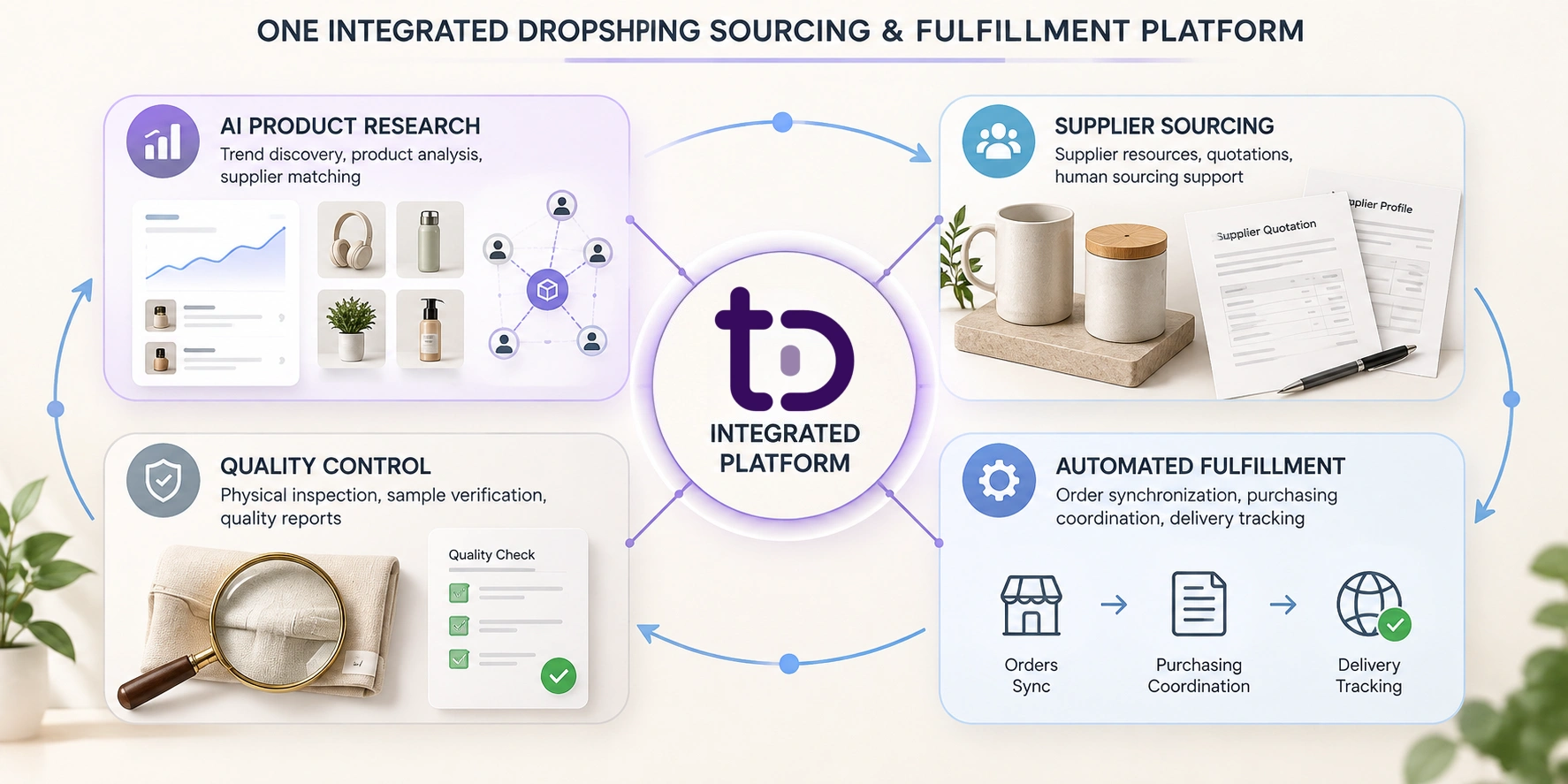
This is where TeemDrop offers a more connected approach. Rather than focusing only on product discovery, TeemDrop combines AI-powered sourcing capabilities, supplier resources, purchasing support, quality inspections, and order fulfillment in one platform.
AI-Powered Product Research and Supplier Matching
TeemDrop helps sellers simplify AI dropshipping sourcing through AI-assisted product research and access to supplier resources.
Sellers can:
- Analyze product trends and potential market opportunities.
- Match product requirements with suitable suppliers.
- Compare product costs and estimated profit margins.
- Source products from Chinese marketplaces such as 1688 and Taobao.
When a product is not available in the existing catalog, sellers can submit a sourcing request with a product link, image, or specific requirements. TeemDrop typically provides sourcing results within 48 hours.
By combining AI-assisted research with human sourcing support, TeemDrop helps sellers move from product discovery to purchasing with fewer manual steps.
From Product Sourcing to Automated Fulfillment
Finding a supplier is only the beginning. TeemDrop also connects product sourcing with the operational processes required to run a dropshipping store.
Its fulfillment services include:
- Store integration: Connect supported ecommerce stores and synchronize product and order information.
- Automated order processing: Reduce manual order forwarding and simplify fulfillment management.
- Global delivery: Access international shipping solutions and warehouse resources.
- 24/7 support: Get assistance with sourcing, purchasing, and fulfillment issues.
Through its automated dropshipping fulfillment system, TeemDrop helps sellers connect store orders with purchasing and shipping operations.
Combined with product sourcing and quality inspections, these services create a more connected workflow from supplier selection to customer delivery.
FAQs
1. What Is AI Dropshipping Sourcing and How Does It Work?
AI dropshipping sourcing uses artificial intelligence to help sellers research products, analyze market trends, match suppliers, and compare purchasing costs. It reduces repetitive research and supports faster, more informed sourcing decisions.
2. Can AI Replace a Traditional Dropshipping Sourcing Agent?
Not completely. AI can automate product research, supplier matching, and data analysis, but human agents remain valuable for negotiations, sample checks, and complex supplier communication. Many sellers benefit from combining both approaches.
3. Is AI Sourcing Cheaper Than Hiring a Sourcing Agent?
AI sourcing can reduce manual research and administrative costs, but it does not eliminate purchasing, inspection, or shipping expenses. The actual cost depends on the platform, agent service fees, product requirements, and fulfillment arrangements.
4. What Is the Difference Between an AI Sourcing Platform and a Traditional Agent?
An AI sourcing platform uses technology to improve product research, supplier matching, and cost analysis. A traditional agent relies on manual research, direct communication, and supplier relationships. Some platforms combine AI tools with human sourcing support.
5. Can an AI Dropshipping Platform Also Handle Order Fulfillment?
Yes, some platforms offer both sourcing and fulfillment services. For example, TeemDrop connects AI-assisted product sourcing with purchasing, quality inspections, order synchronization, and global delivery. Available services depend on the platform.
Final Thoughts: AI and Human Expertise Can Work Together
The difference between AI dropshipping sourcing and traditional agents comes down to how sellers manage product research, supplier relationships, purchasing costs, and order fulfillment.
AI improves sourcing efficiency through data analysis and automation, while traditional agents provide hands-on support for negotiation and complex purchasing requirements. Combining both approaches can help sellers balance efficiency with supply chain control.
TeemDrop connects AI-assisted product sourcing, supplier resources, quality control, and automated fulfillment in one platform, helping sellers simplify the process from product discovery to customer delivery.
References
[1] IBM – Optimizing Contract Management in Procurement with AI
[2] USAdrop – Dropshipping Agent vs. Sourcing Agent: Key Differences Explained