DropshippingBest Dropshipping Platforms in 2026: Which Solution Is Right for Your Shopify Store?
Best Dropshipping Platforms in 2026: Which Solution Is Right for Your Shopify Store?
The best dropshipping platforms in 2026 vary in sourcing capabilities, automation, fulfillment quality, and scalability. Choosing the right solution depends on your business stage, growth goals, and operational needs.
Best Dropshipping Platforms in 2026: Which Solution Is Right for Your Shopify Store?
Starting a Shopify store is easier than ever. Finding the right dropshipping platform is often the bigger challenge.
Many new sellers spend most of their time searching for winning products, but the platform behind their business often has a much greater impact on long-term success. As one seller shared in a Reddit discussion, "The hardest part isn't setting up a store, it's everything after," including supplier management, shipping, and fulfillment challenges.[1]
In 2026, the best dropshipping platforms do more than import products. They help sellers source products, manage suppliers, fulfill orders, and scale operations more efficiently.
Platforms like TeemDrop, Zendrop, AutoDS, DSers, CJdropshipping, and Spocket all offer different strengths. Some focus on automation, while others provide stronger sourcing and fulfillment support.
In this guide, we'll compare the best dropshipping platforms in 2026, explain who they're best suited for, and help you choose the right solution based on your business stage.
What Makes the Best Dropshipping Platform in 2026?
Not all dropshipping platforms solve the same problems. Before comparing options, it's important to understand what actually matters when evaluating a platform.
Product Sourcing Flexibility
Many sellers begin by choosing products from an existing marketplace. However, as stores grow, they often need greater flexibility in dropshipping product sourcing.
The ability to request products, work with suppliers, and find alternatives can become a major advantage when trends change or suppliers become unreliable.
Fulfillment Efficiency
Order fulfillment directly affects customer experience.
A strong platform should help automate order processing, provide tracking updates, and provide reliable fulfillment services that reduce the amount of manual work required to manage daily operations.
Shipping Speed
Customers expect faster delivery than ever before. In a recent Reddit discussion, one seller noted that "customers now expect fast shipping, so AliExpress isn’t really cutting it anymore," highlighting how delivery speed has become a major factor in ecommerce success.[2]
Platforms that offer warehousing or stronger fulfillment networks often provide more consistent shipping performance than traditional supplier marketplaces.
Product Quality Control
Poor product quality can quickly damage a store's reputation.
Quality inspection services, supplier verification, and product checks can help reduce refund rates and improve customer satisfaction.
Scalability
A platform that works well for a beginner may not be suitable for a store processing hundreds of orders every day.
The best dropshipping platform should be able to support growth without creating operational bottlenecks.
Top 8 Best Dropshipping Platforms in 2026
The best dropshipping platform depends on your business model, target market, and growth stage.
Some sellers prioritize automation, while others focus on sourcing flexibility, fulfillment support, or faster shipping.
Below are the top dropshipping platforms worth considering in 2026.
Platform
Best For
Monthly Fee
Sourcing Flexibility
Fulfillment Support
TeemDrop
Flexible sourcing
Free
High
High
Zendrop
Beginners
Paid
Medium
High
AutoDS
Automation
Paid
Medium
Medium
DSers
AliExpress sellers
Free/Paid
Low
Medium
CJdropshipping
Product variety
Free
Medium
High
Spocket
US & EU suppliers
Paid
Medium
Medium
SaleHoo
Supplier directory
Paid
Medium
Low
Printful
POD
Paid
Low
High
1. TeemDrop
Best for Flexible China Sourcing and Fulfillment
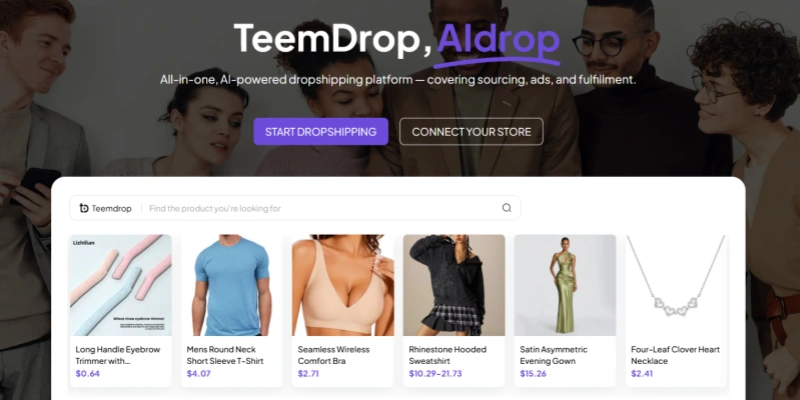
TeemDrop is designed for sellers who want more than basic product importing. Instead of relying solely on a fixed product catalog, sellers can request product sourcing, work with supplier networks in China, and access warehousing and fulfillment services through a single platform.
This approach gives merchants more flexibility when searching for products and more control over their supply chain as their business grows.
Key Features
AI-assisted product sourcing
China supplier network
Quality inspection services
Warehousing support
Order fulfillment
Shopify integration
Pros
Flexible sourcing options
Warehousing and fulfillment support
Quality control services
Suitable for scaling stores
No monthly platform fee
Cons
More beneficial for growing stores than very small hobby stores
Best For
Sellers who want sourcing, quality inspection, warehousing, and fulfillment support in one solution.
2. Zendrop
Best for Beginners
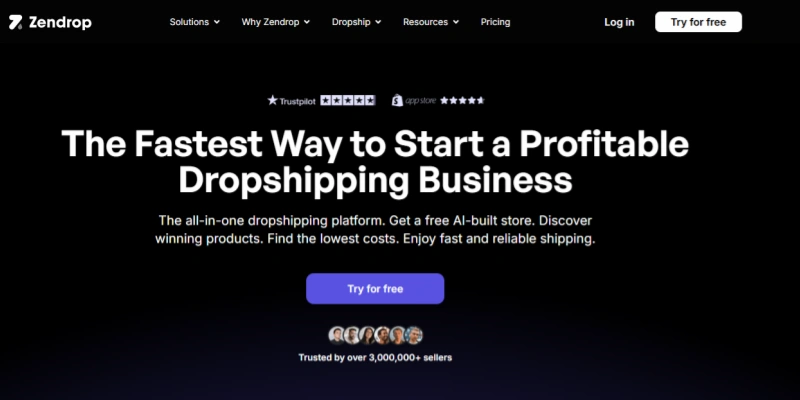
Zendrop has become one of the most popular platforms among new Shopify sellers and is often compared as a Zendrop alternative when merchants evaluate different fulfillment and sourcing solutions. The platform focuses on simplicity, making it easy to import products and automate order fulfillment without a steep learning curve.
Its user-friendly dashboard and beginner-focused tools make it attractive for first-time ecommerce entrepreneurs.
Key Features
Product importing
Automated fulfillment
Shopify integration
Supplier access
Product sourcing requests
Pros
Easy setup process
Beginner-friendly interface
Automation tools included
Strong educational resources
Cons
Limited sourcing flexibility compared to dedicated sourcing platforms
Advanced features often require paid plans
Best For
New sellers launching their first Shopify store.
3. AutoDS
Best for Automation
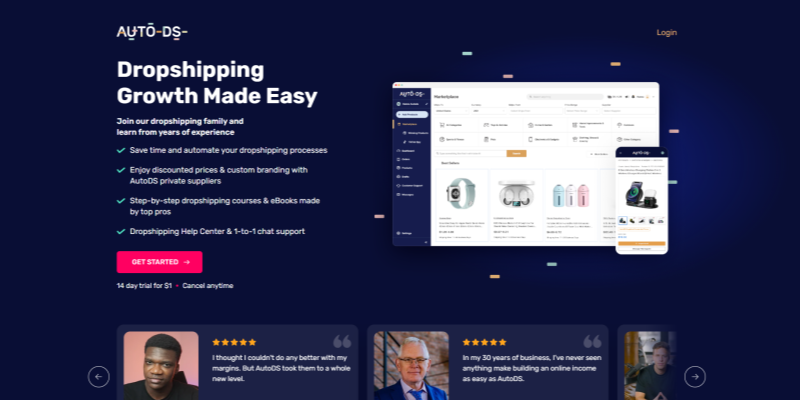
AutoDS focuses heavily on automation. It helps sellers automate product importing, inventory monitoring, price updates, and order fulfillment.
For merchants managing large product catalogs, automation can save significant time and reduce manual tasks.
Key Features
Product importing
Inventory monitoring
Price automation
Order automation
Product research tools
Pros
Strong automation features
Helps reduce manual work
Useful for managing large catalogs
Cons
Costs can increase as additional features are added
Less focused on sourcing and supplier relationships
Best For
Sellers prioritizing automation and operational efficiency.
4. DSers
Best for AliExpress Sellers
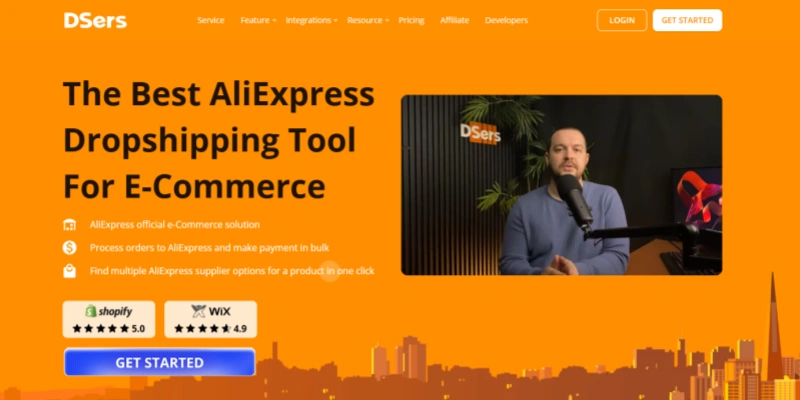
DSers remains one of the most widely used AliExpress dropshipping tools. It allows sellers to import products, place bulk orders, and manage multiple suppliers within a familiar workflow.
For beginners looking for a low-cost entry point into dropshipping, DSers remains a popular choice.
Key Features
AliExpress integration
Bulk order processing
Product importing
Supplier management
Shopify integration
Pros
Affordable
Easy to use
Large product selection through AliExpress
Cons
Highly dependent on AliExpress suppliers
Shipping times can vary significantly
Best For
Sellers who want to start with AliExpress dropshipping.
5. CJdropshipping
Best for Product Variety
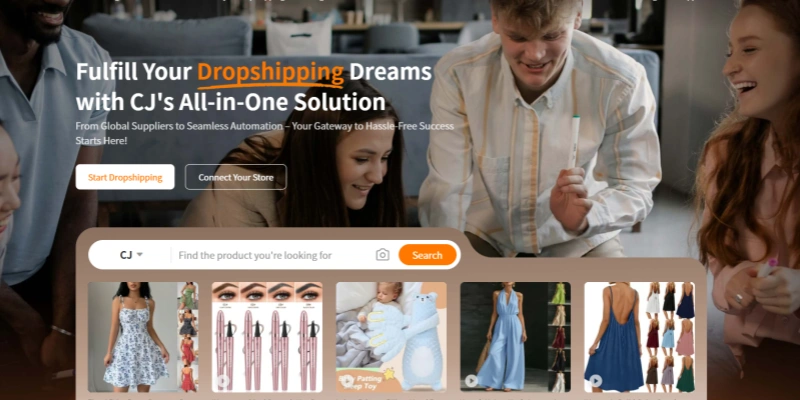
CJdropshipping combines a large product catalog with sourcing services and fulfillment support. Many sellers use CJdropshipping as an alternative to AliExpress because it offers additional sourcing options and fulfillment capabilities.
Key Features
Product sourcing
Large product catalog
Fulfillment services
Warehouse options
Shopify integration
Pros
Extensive product selection
Sourcing assistance
Multiple fulfillment options
Cons
Product quality can vary between suppliers
User experience may feel overwhelming for beginners
Best For
Sellers looking for a wide variety of products and sourcing options.
6. Spocket
Best for US & EU Suppliers
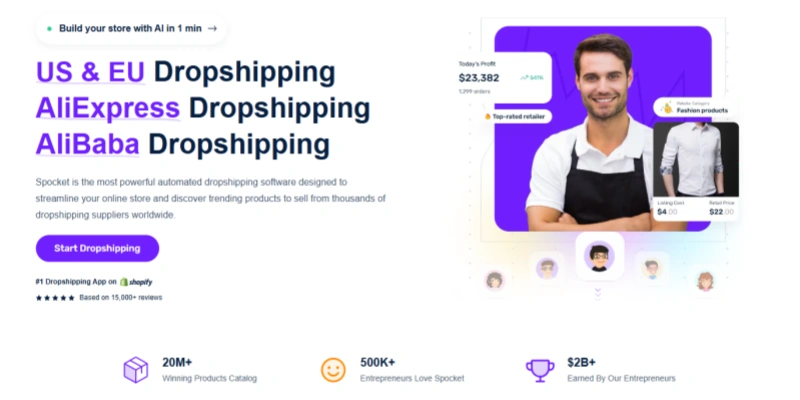
Spocket focuses on suppliers based in the United States and Europe. This allows some sellers to offer faster shipping times to customers in these markets.
The platform is often chosen by merchants targeting premium customers who value quicker delivery.
Key Features
US suppliers
EU suppliers
Product importing
Automated inventory updates
Shopify integration
Pros
Faster shipping in some regions
Local supplier network
Higher perceived product quality
Cons
Product costs are often higher
Smaller product selection than global marketplaces
Best For
Stores targeting customers in North America and Europe.
7. SaleHoo
Best Supplier Directory
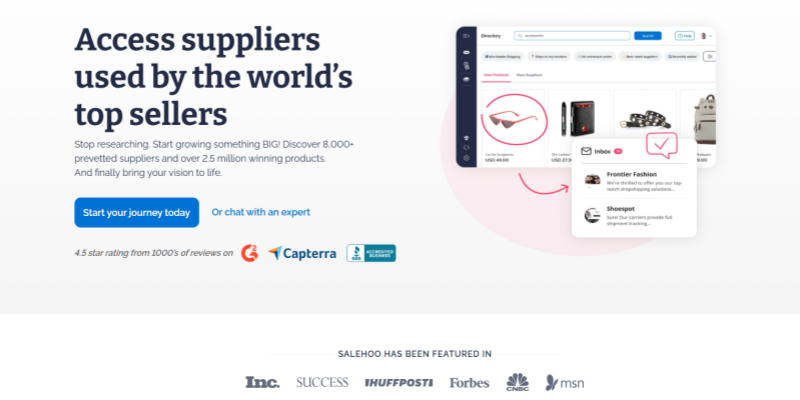
Unlike many dropshipping platforms, SaleHoo focuses primarily on supplier discovery. It provides a large directory of suppliers and educational resources to help sellers identify potential sourcing partners.
Key Features
Supplier directory
Market research tools
Educational resources
Supplier verification
Pros
Large supplier database
Useful learning resources
Good for supplier research
Cons
Not a complete fulfillment platform
Requires additional tools for operations
Best For
Sellers looking to research and connect with suppliers.
8. Printful
Best for Print-on-Demand
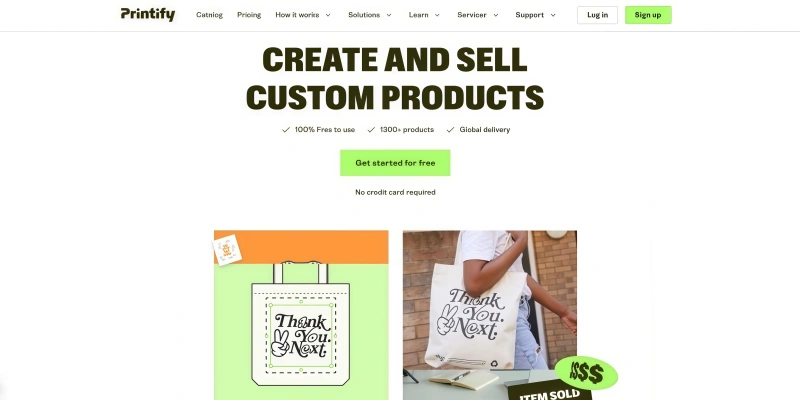
Printful specializes in print-on-demand products, allowing sellers to create customized merchandise without holding inventory.
For creators, influencers, and niche brands, Printful remains one of the most reliable POD solutions available.
Key Features
Print-on-demand fulfillment
Custom branding
Warehousing options
Shopify integration
Pros
Reliable POD infrastructure
Custom branding options
No inventory requirements
Cons
Limited outside the POD niche
Higher product costs compared to standard dropshipping
Best For
Businesses selling customized or branded products.
Best Dropshipping Platform Stacks for Different Business Stages
One of the biggest mistakes sellers make is assuming the same setup works at every stage of growth.
In reality, the tools that help launch a store are often different from the tools needed to scale one.
Best Dropshipping Stack for Beginners
Shopify + DSers
If you're launching your first Shopify store, simplicity should be your priority.
Many beginners spend too much time worrying about advanced fulfillment systems before they've even validated a product. At this stage, the goal is to learn how ecommerce works, test product demand, and gain experience.
Shopify provides an easy-to-use storefront, while DSers offers a simple way to import products from AliExpress and fulfill orders.
Why This Stack Works
Low startup costs
Easy product testing
Simple setup process
Best For
First-time sellers
Product testing
Limited budgets
Potential Limitations
As sales grow, shipping speed and supplier consistency may become challenges.
Best Dropshipping Stack for Growing Shopify Stores
Shopify + Zendrop
Once a store begins generating consistent orders, efficiency becomes more important.
Zendrop helps automate fulfillment and reduce manual work associated with order management.
For sellers moving beyond the testing stage, this combination can improve operational efficiency without adding too much complexity.
Why This Stack Works
Better automation
Easier order management
Beginner-friendly transition to growth
Best For
Growing stores
Sellers seeking automation
Small teams
Potential Limitations
Sourcing flexibility remains somewhat limited compared to dedicated sourcing-focused solutions.
Best Dropshipping Stack for Scaling Ecommerce Brands
Shopify + TeemDrop
Many stores perform well during the testing phase but face new challenges once order volume increases.
At 50, 100, or more orders per day, sourcing reliability, fulfillment consistency, and product quality often become more important than finding additional products.
This is where a sourcing and fulfillment-focused platform can provide significant value.
With Shopify managing storefront operations and TeemDrop supporting sourcing, quality inspection, warehousing, and fulfillment, sellers can build a more stable supply chain that supports long-term growth.
Why This Stack Works
Better supplier coordination
More fulfillment control
Quality inspection support
Improved scalability
Best For
Scaling stores
High-volume sellers
Brands investing in paid advertising
Best Dropshipping Stack for Faster Shipping
Shopify + TeemDrop Warehousing
Shipping speed has become a major competitive advantage.
Many customers now expect delivery times that traditional dropshipping models struggle to provide.
By combining Shopify with warehousing support and stronger global delivery capabilities, sellers can reduce fulfillment delays and create a more predictable customer experience.
Why This Stack Works
Faster shipping
Better inventory management
Improved customer satisfaction
Best For
US-focused stores
TikTok Shop sellers
Repeat-purchase products
Best Dropshipping Stack for Building a Brand
Shopify + TeemDrop + Custom Packaging
Many successful ecommerce businesses eventually move beyond simple dropshipping and focus on building a recognizable brand.
Custom packaging, better product consistency, and stronger supplier relationships can help create a more professional customer experience.
Why This Stack Works
Greater brand control
Better customer experience
Stronger supplier relationships
Best For
Long-term ecommerce brands
Businesses focused on customer retention
Why More Shopify Sellers Are Moving Beyond Traditional Dropshipping
The dropshipping industry continues to evolve.
While product importing remains important, more sellers are paying attention to supply chain management.
Long shipping times, inconsistent suppliers, and quality issues have pushed many businesses to look for more reliable solutions.
Today, successful Shopify stores increasingly prioritize customer experience, fulfillment efficiency, and operational reliability. As customer acquisition costs continue to rise, retaining customers through reliable fulfillment and positive buying experiences has become more important than ever.[3]
This shift explains why sourcing and fulfillment-focused platforms have become more popular among growing ecommerce brands.
Instead of relying entirely on marketplace suppliers, many sellers are seeking greater control over how products are sourced, stored, inspected, and delivered.
Final Verdict: Which Dropshipping Platform Should You Choose?
The best dropshipping platform depends on your goals and stage of growth.
Choose DSers if you're a beginner looking for a simple and affordable way to start with AliExpress.
Choose Zendrop if you want a beginner-friendly platform with stronger automation.
Choose AutoDS if automation and workflow efficiency are your top priorities.
Choose CJdropshipping if product variety and sourcing options are most important.
Choose Spocket if you prefer working with suppliers based in the US and Europe.
Choose TeemDrop if you're looking for a solution that combines sourcing, warehousing, quality inspection, and fulfillment support to help your business scale more efficiently.
As competition increases in 2026, the stores that succeed will not simply find good products—they will build stronger supply chains.
FAQ
What is the best dropshipping platform for Shopify?
The best platform depends on your goals. DSers and Zendrop are popular for beginners, while TeemDrop is better suited for sellers who need sourcing, warehousing, and fulfillment support.
What is the difference between a dropshipping platform and a supplier?
A supplier provides products. A dropshipping platform helps manage sourcing, fulfillment, inventory, and order processing.
Which dropshipping platform offers faster shipping?
Platforms with warehousing and fulfillment support typically provide faster and more reliable shipping than marketplace-based suppliers.
What should I look for in a dropshipping platform?
Focus on sourcing flexibility, fulfillment support, shipping speed, product quality, and Shopify integration.
Is TeemDrop suitable for beginners?
Yes. Beginners can use TeemDrop to source and fulfill products, while growing stores can benefit from its warehousing and fulfillment services.
References
[1] Reddit —How hard is it to start dropshipping as a beginner?
More winning products. More sales opportunities. More profits.
Join Teemdrop's VIP community for expert insights, global bestsellers, business roundtables, and exclusive business opportunities to grow your eCommerce profits.