How to Calculate Dropshipping Product Profit Margins
A product sells for $40, and you pay your supplier $12. It may seem like you've made $28 in profit, but shipping, payment processing, advertising, and other expenses can reduce your actual earnings.
Understanding dropshipping profit margins helps you evaluate products, set prices, and decide whether scaling your store makes financial sense. TeemDrop supports product sourcing, supplier coordination, quality control, and order fulfillment, while accurate cost calculations help you make informed business decisions.
This guide explains how to calculate product profit margins, identify hidden costs, and set prices that support sustainable profits.
Quick Answer: How Do You Calculate Dropshipping Profit Margin?
To calculate your dropshipping profit margin, subtract all business expenses from net sales revenue to find your net profit. Then divide net profit by net revenue and multiply by 100%. Include product costs, shipping, fulfillment, platform fees, payment processing, advertising, and operating expenses to measure your actual profitability.
Formula:
Net Profit Margin = (Net Profit ÷ Net Revenue) × 100%
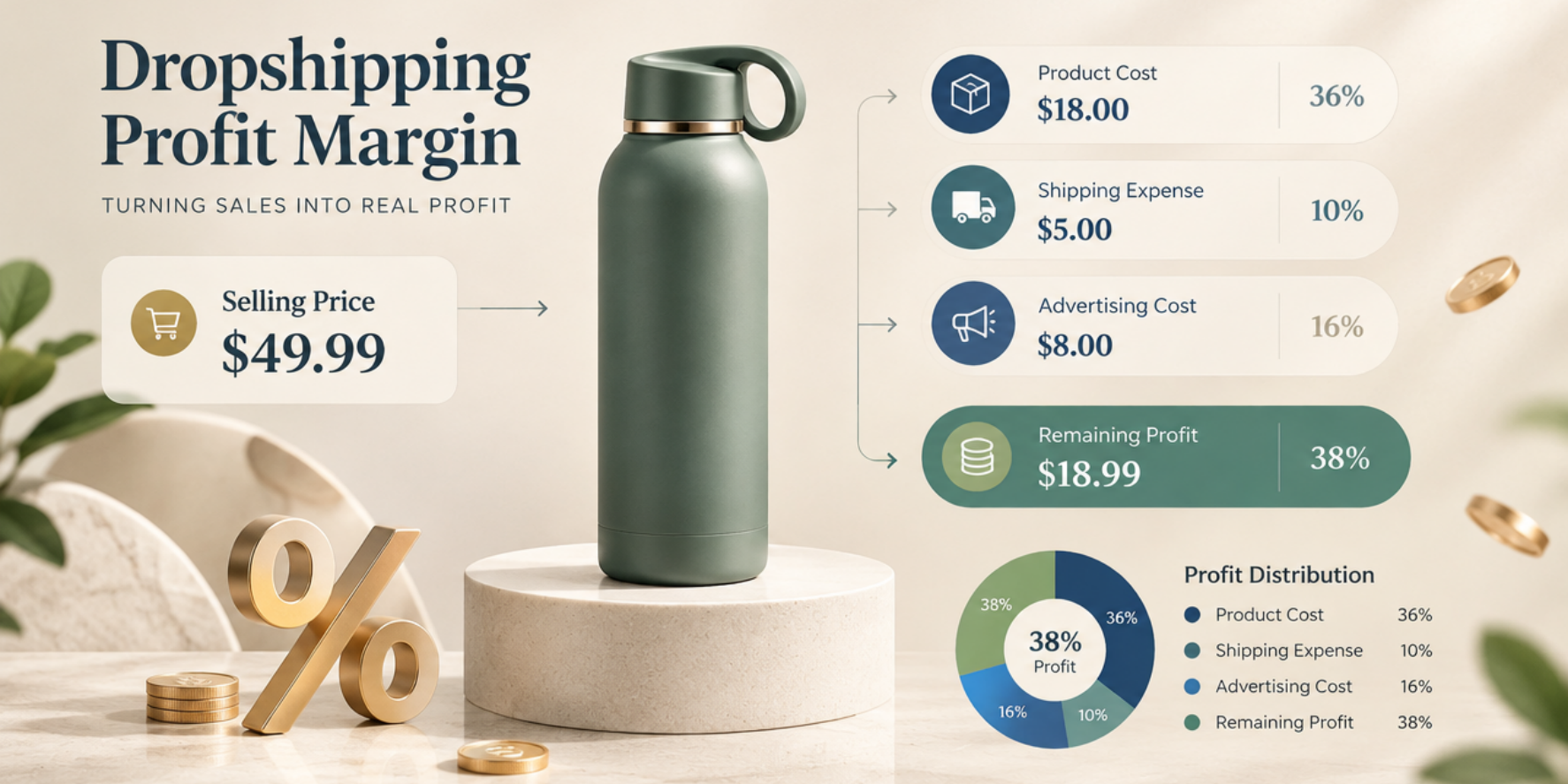
What Is a Dropshipping Profit Margin?
Profit margin is the percentage of sales revenue left after deducting expenses. It shows how much of each sale your business keeps as profit.
For example, if a product sells for $50 and generates $10 in profit, its profit margin is 20%.
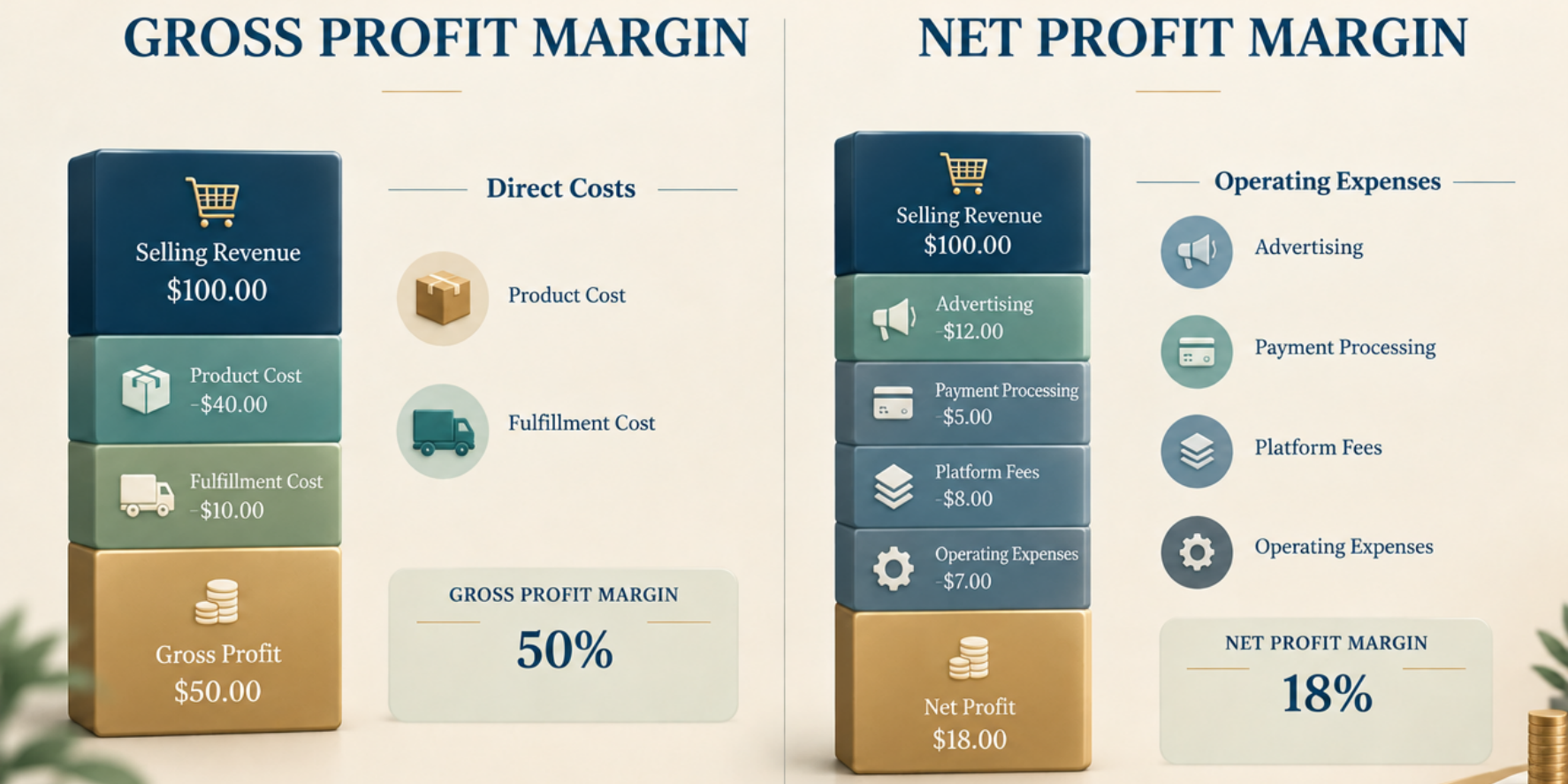
Dropshipping sellers should understand two main types of profit margin: gross profit margin and net profit margin.
Gross Profit Margin vs. Net Profit Margin
Gross profit margin measures the revenue remaining after deducting direct product and fulfillment costs, such as supplier prices and shipping.
Gross Profit Margin = (Net Revenue − Direct Product Costs) ÷ Net Revenue × 100%
Net profit margin accounts for additional expenses, including advertising, platform fees, payment processing, and operating costs.
Net Profit Margin = Net Profit ÷ Net Revenue × 100%
Net profit margin provides a broader view of profitability because it considers more of the costs involved in running your store. [1]
Profit Margin vs. Markup: What's the Difference?
Profit margin and markup measure profitability differently. Suppose a product costs $20 and sells for $40:
- Profit: $40 − $20 = $20
- Profit Margin: $20 ÷ $40 × 100% = 50%
- Markup: $20 ÷ $20 × 100% = 100%
Profit margin compares profit with the selling price, while markup compares profit with product cost. Knowing the difference helps you avoid underpricing products.
What Costs Should You Include When Calculating Dropshipping Profit Margins?
One common mistake beginners make is calculating profit using only the product purchase price. In reality, several expenses can reduce your earnings.
Here are the main costs to include in your dropshipping profit calculation.
| Cost Category |
What to Include |
| Product Cost |
Supplier purchase price |
| Shipping & Fulfillment |
Shipping, handling, and fulfillment charges |
| Platform Fees |
Store subscriptions and marketplace selling fees |
| Payment Processing |
Transaction and payment processing fees |
| Advertising |
Facebook, TikTok, and Google Ads |
| Additional Expenses |
Refunds, replacements, discounts, and currency conversion |
| Operating Costs |
Software subscriptions and other fixed expenses |
1. Product Sourcing Costs
Product cost is often one of the largest expenses in dropshipping. Supplier prices can vary, while product quality, minimum order quantities, customization, and reliability also affect your total sourcing costs.
Platforms such as 1688 and Taobao provide access to manufacturers and wholesale products, but the lowest quote is not always the best choice. Poor quality can result in refunds and replacements.
When comparing free dropshipping suppliers, consider product quality, communication, and fulfillment reliability—not just the purchase price.
2. Shipping and Fulfillment Costs
Shipping can significantly affect dropshipping profit margins, especially for international orders. Include:
- International shipping and local delivery fees
- Handling and fulfillment charges
- Applicable customs duties or import fees
Costs vary by product weight, dimensions, destination, and delivery method. For example, an $8 shipping charge can substantially reduce the profit on a product that costs $10.
TeemDrop supports global shipping and local fulfillment options, helping sellers compare suitable fulfillment arrangements based on their target markets and order requirements. Its global delivery services provide additional fulfillment options for businesses selling to international customers.
3. Platform and Payment Processing Fees
Selling platforms and payment providers may charge subscription, transaction, and processing fees. Shopify's charges vary by plan, payment method, and market, so include them in your pricing calculations. [2]
Even small fees can add up across many orders. Check your platform's current pricing instead of relying on fixed estimates.
4. Advertising and Operating Costs
If you use paid ads, include the cost of acquiring each order in your dropshipping marketing budget. Evaluate advertising by the orders and revenue it generates, not just clicks or impressions.
For example, spending $200 to generate 20 orders means an average advertising cost of $10 per order.
Also include recurring expenses such as software subscriptions and store costs. Divide monthly expenses by your expected order volume to estimate the operating cost per order.
How to Calculate Dropshipping Profit Margins Step by Step
Use these five steps to calculate your profit per product and decide whether it is worth selling.
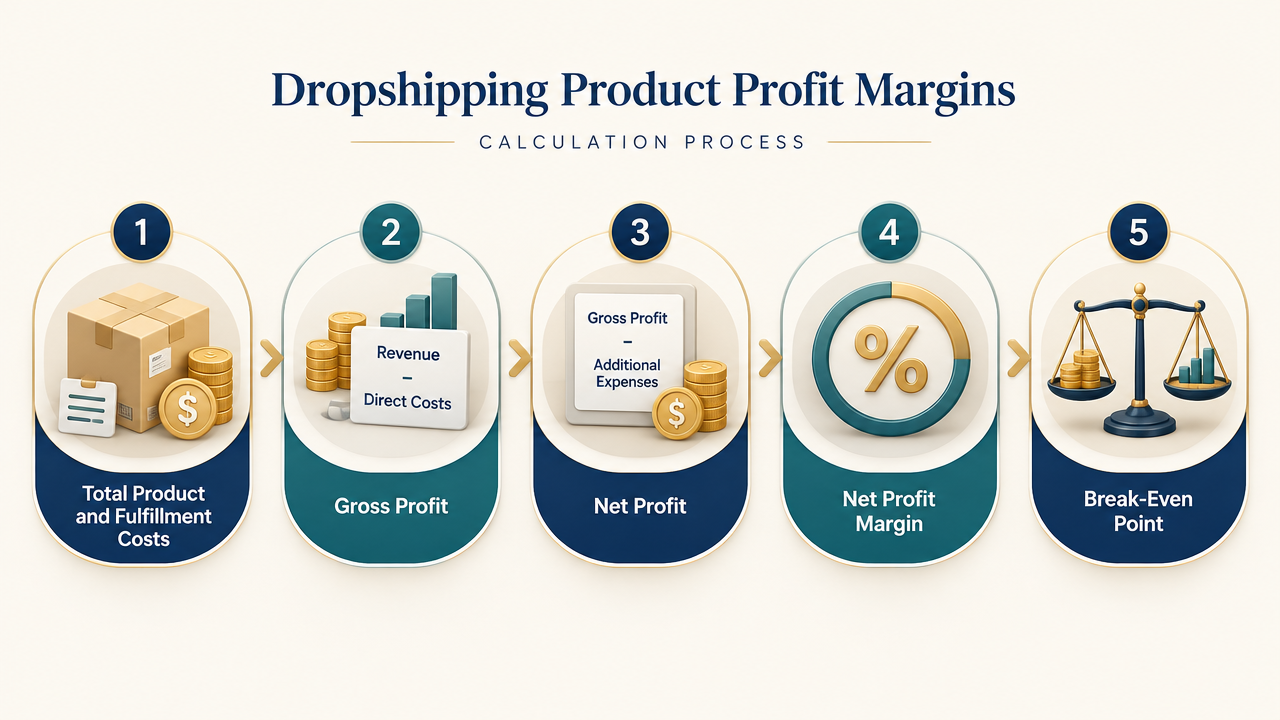
Step 1. Calculate Your Total Product and Fulfillment Costs
Add the supplier's price, shipping, and other direct fulfillment expenses.
Total Direct Cost = Product Cost + Shipping Cost + Fulfillment Cost
For example:
- Product cost: $18
- Shipping cost: $6
- Additional fulfillment cost: $0
Total Direct Cost = $24
Do not count fulfillment fees twice if they are already included in your shipping quote.
Step 2. Calculate Your Gross Profit
Subtract direct product and fulfillment costs from net sales revenue.
Gross Profit = Net Revenue − Direct Product Costs
For a product with $50 in net revenue and $24 in direct costs:
Gross Profit = $50 − $24 = $26
Step 3. Calculate Your Net Profit
Gross profit does not account for every expense involved in running your store. To calculate net profit, subtract all applicable business expenses, including product costs, shipping, payment fees, advertising, and allocated operating costs.
Net Profit = Net Revenue − Total Business Expenses
Calculate net revenue after discounts and refunds. Exclude sales taxes collected on behalf of tax authorities.
Step 4. Calculate Your Net Profit Margin
Once you know your net profit, calculate your margin:
Net Profit Margin = (Net Profit ÷ Net Revenue) × 100%
For example, if net revenue is $50 and net profit is $10:
Net Profit Margin = ($10 ÷ $50) × 100% = 20%
Use this metric to compare the profitability of different products.
Step 5. Calculate Your Break-Even Point
Your break-even point is the number of orders needed to cover your monthly fixed costs.
Break-Even Orders = Monthly Fixed Costs ÷ Contribution per Order
Contribution per order is the selling price minus variable costs, such as product costs, shipping, transaction fees, and per-order advertising expenses.
For example, if monthly fixed costs are $300 and each order contributes $15:
Break-Even Orders = $300 ÷ $15 = 20 orders
You need 20 orders to cover your fixed costs. This follows the basic break-even calculation used by the U.S. Small Business Administration. [3]
Dropshipping Profit Margin Calculation Example
Consider a wireless charging accessory with a selling price of $49.99. The following example shows how to calculate its profit.
| Expense |
Cost |
| Selling Price |
$49.99 |
| Product Cost |
$18.00 |
| Shipping Cost |
$6.00 |
| Platform & Payment Fees |
$2.50 |
| Advertising Cost |
$10.00 |
| Allocated Operating Cost |
$1.50 |
| Total Expenses |
$38.00 |
| Net Profit |
$11.99 |
Net Profit Margin = ($49.99 − $38.00) ÷ $49.99 × 100% = 24.0%
Profit per Order
- Selling Price: $49.99
- Total Expenses: $38.00
- Net Profit: $11.99
- Net Profit Margin: 24.0%
Illustrative example. Excludes additional refunds, seller-paid taxes, and unlisted expenses.
This shows why revenue alone does not indicate whether a product is profitable.
Now consider what happens if shipping costs increase by $3.
| Scenario |
Shipping Cost |
Net Profit |
| Original |
$6.00 |
$11.99 |
| Higher Shipping Cost |
$9.00 |
$8.99 |
| Lower Shipping Cost |
$4.00 |
$13.99 |
Even a small change in shipping costs can affect your final earnings. This is why you should review your actual order costs regularly instead of relying only on the original product price.
How to Price Dropshipping Products for Your Target Profit Margin
Once you understand your costs, the next step is setting a selling price that covers your expenses and leaves enough profit.
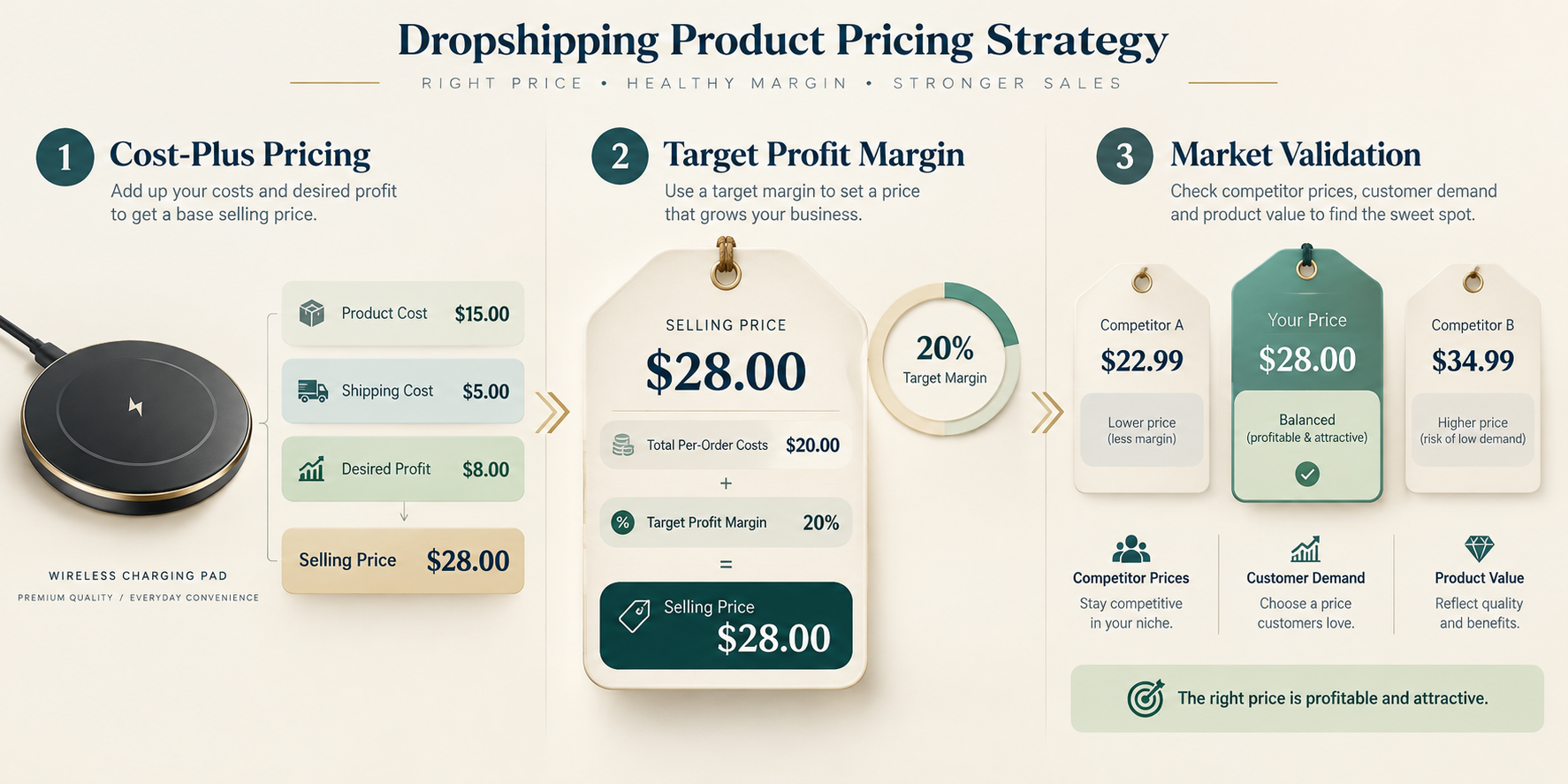
1. Start With Cost-Plus Pricing
Cost-plus pricing means adding a profit amount to your total product and fulfillment costs.
For example, if your total direct cost is $20 and you want to earn $15 before other expenses, your starting price would be $35.
However, remember to account for payment fees, advertising, and other expenses before deciding on your final selling price.
2. Calculate Your Price Based on a Target Profit Margin
You can also work backward from your desired profit margin to determine the right selling price.
Use this formula:
Selling Price = Fixed Costs per Order ÷ (1 − Variable Fee Rate − Target Profit Margin)
Suppose:
- Product and shipping costs: $24
- Other per-order costs: $1.50
- Percentage-based fees: 3%
- Target profit margin: 20%
Calculation:
Selling Price = $25.50 ÷ (1 − 0.03 − 0.20)
Selling Price = $25.50 ÷ 0.77 = $33.12
A price of approximately $33.12 would achieve a 20% target margin under these assumptions. This formula assumes percentage-based fees are calculated from the selling price and all other per-order expenses are included in the $25.50.
3. Check Competitor Prices and Customer Demand
A mathematically profitable price does not guarantee sales.
Before listing a product, compare similar products, check customer demand, and consider what makes your offer different.
Some high margin dropshipping products trending now may look attractive, but their actual profitability depends on sourcing costs, competition, advertising performance, and customer expectations.
Your selling price should balance profitability with what customers are willing to pay. TeemDrop's product research tools can help sellers explore product opportunities before deciding what to list.
How to Improve Dropshipping Profit Margins
Calculating your profit margin is only the first step. The next challenge is finding ways to keep more money from every order without reducing product quality or customer satisfaction.
Here are four practical ways to improve your dropshipping business profitability.
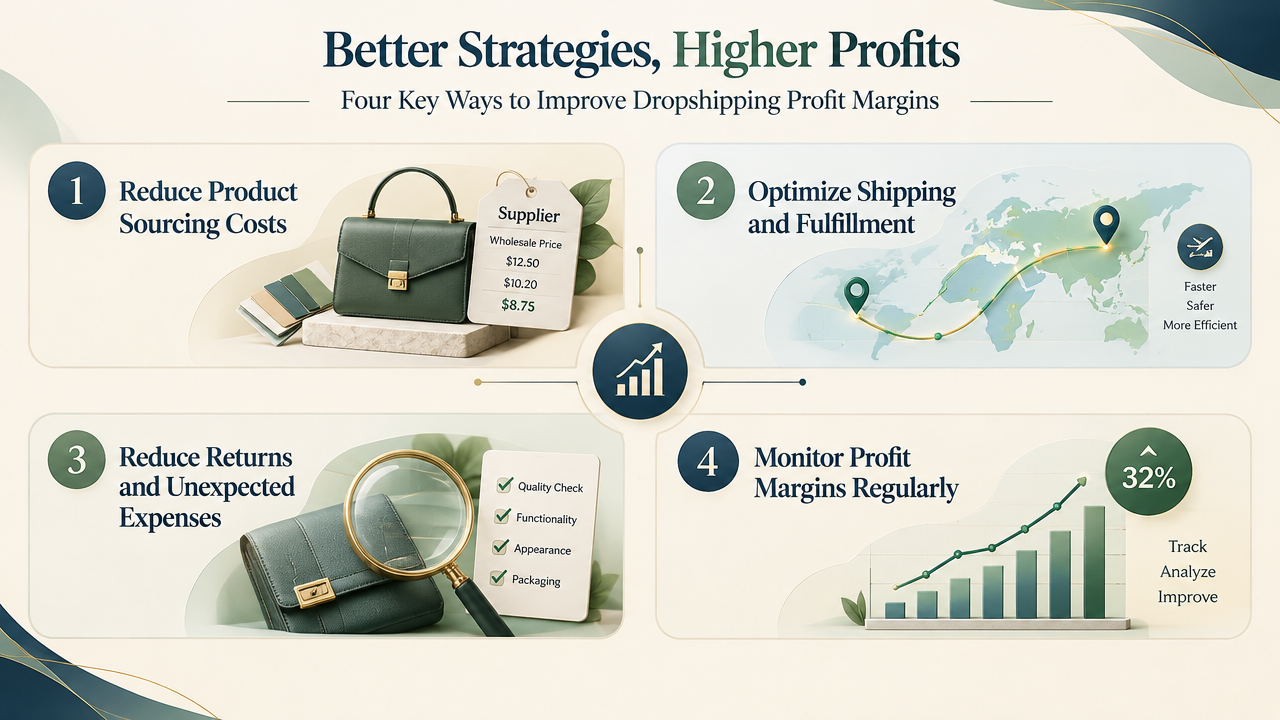
1. Reduce Product Sourcing Costs
Your supplier's price directly affects how much profit you can make.
Instead of choosing the first supplier you find, compare product prices, quality, and delivery conditions across different suppliers.
For example, sourcing through 1688 and Taobao can give sellers access to a wider range of manufacturers and wholesale products.
TeemDrop connects sellers with Chinese suppliers and supports AI-powered product sourcing, helping simplify supplier matching and product cost evaluation. Its product sourcing agent also supports supplier coordination and product purchasing.
2. Optimize Shipping and Fulfillment Costs
Shipping expenses can reduce margins, especially when selling internationally. Compare shipping methods, destinations, and fulfillment options before choosing a solution.
For stores with consistent demand in a specific market, local warehousing may reduce cross-border shipping costs and improve delivery efficiency. TeemDrop offers local fulfillment options as sellers expand into new markets.
3. Reduce Returns and Unexpected Expenses
A cheap product is not necessarily a profitable product.
Poor quality, damaged items, and incorrect orders can lead to refunds, replacements, and additional customer service expenses.
Working with reliable suppliers and checking product quality before shipment can help reduce these risks.
TeemDrop provides product quality control, including inspection services to help sellers identify product issues before orders are shipped.
4. Monitor Your Profit Margins Regularly
Product costs, shipping rates, and advertising expenses can change over time.
Review your order-level profit regularly and pay attention to:
- Changes in supplier purchase prices.
- Increases in shipping and fulfillment charges.
- Advertising cost per purchase.
- Refund and replacement rates.
- Actual profit compared with your target margin.
If your store generates more orders but your profit keeps declining, increasing sales alone will not solve the problem.
TeemDrop's dropshipping pricing provides information about service costs, helping sellers evaluate sourcing and fulfillment expenses when planning their budgets.
The goal is to build a business where each additional order contributes positively to your overall profitability.
FAQs
1. What's a Good Profit Margin for Dropshipping?
There is no universal benchmark. A suitable margin depends on product costs, advertising, platform fees, and fulfillment expenses. Focus on maintaining a positive net profit margin after all relevant costs.
2. How Do You Calculate Profit Per Product in Dropshipping?
Subtract all product, shipping, payment, platform, advertising, and allocated operating costs from net sales revenue. The remaining amount is your net profit per order.
3. Should Shipping Costs Be Included in Dropshipping Profit Margins?
Yes. Include the shipping charges you pay to deliver orders. Even when you offer free shipping to customers, the delivery cost still affects your profit margin.
4. How Much Can Dropshipping Make a Month?
Monthly income depends on order volume and actual profit per order. For example, 300 orders earning $12 each generate $3,600 before additional unallocated business expenses. Always distinguish revenue from profit.
5. How Can I Reduce TeemDrop Costs?
TeemDrop does not require a monthly platform subscription or charge a separate platform service fee. Sellers pay for the products and fulfillment services they use. Actual costs depend on product selection, sourcing requirements, shipping methods, and destination.
Comparing product and shipping costs before placing orders helps you estimate your expenses and manage your profit margins more effectively.
Final Thoughts: Calculate Your Margins Before Scaling Your Store
Understanding dropshipping profit margins helps you make better decisions about product selection, pricing, advertising, and fulfillment.
Profitability starts before the first order arrives. Competitive sourcing, controlled shipping costs, and consistent product quality all contribute to a healthier business.
TeemDrop supports AI-powered sourcing, supplier coordination, quality control, and global fulfillment to help simplify your operations and manage costs.
Ready to build a more cost-efficient dropshipping business?
Find products, compare sourcing options, and streamline your order fulfillment with TeemDrop.
References
[1] Shopify. How to Increase Profit Margin: 6 Ways.
https://www.shopify.com/blog/profit-margin
[2] Shopify. Shopify Pricing – Plans and Payment Processing Rates.
https://www.shopify.com/pricing
[3] U.S. Small Business Administration. Break-Even Point Calculator.
https://www.sba.gov/counseling/plan-your-business/break-even-point-calculator/