The 2026 Dropshipping Business Plan Framework Suppliers and Investors Sign Off On
A business plan that holds up under supplier or investor scrutiny in 2026 looks nothing like the templates you find on generic business plan sites — and writing the wrong version wastes weeks on sections nobody actually reads.
This framework is built specifically for dropshipping. It covers what suppliers, payment processors, and outside investors actually look at when they review a dropshipping operation today: unit economics, fulfillment infrastructure, chargeback exposure, and brand defensibility. It also calls out the sections most founders over-polish at the expense of the ones that move the needle.

Why Most Dropshipping Business Plans Fail Reviews
The problem is rarely poor writing. It is misaligned priorities.
Founders spend hours on a mission statement and a five-year revenue projection, then submit a plan with no mention of their return rate, no supplier agreement on file, and no explanation of how orders are fulfilled when volume spikes. A payment processor reviewing that plan will flag the account. A supplier will not prioritize your orders. An investor will pass.
The sections that matter in 2026 are operational and financial. The sections that do not matter are the ones that belong in a brand deck.
The Framework: Section by Section
1. Executive Summary (One Page, Outcomes Only)
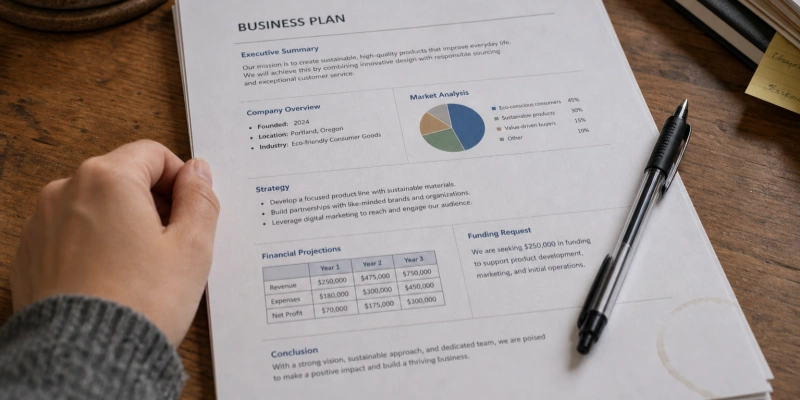
Write this last. Keep it to one page. State what you sell, who buys it, how orders are fulfilled, and what the numbers look like today or at launch.
Investors read this first and use it to decide whether to keep reading. Suppliers rarely read it at all. Skip the mission statement. Put your current monthly revenue or projected first-90-day revenue, your primary product category, and your fulfillment model in plain language.
Example framing: "We operate a Shopify store selling [category] to [audience]. Orders fulfill automatically through a third-party logistics partner with multi-stage quality control. Current monthly revenue: $X. Target 12-month revenue: $Y."
That is enough. Move on.
2. Business Model and Revenue Structure
This is the section suppliers and investors read most carefully, and it is where most dropshipping plans fall apart.
Answer three questions clearly:
How do you make money? State your average order value, your product cost range, and your gross margin. If your products cost $3 and you sell them for $29, say so. Vagueness here reads as ignorance.
How do orders get fulfilled? Name your fulfillment partner, describe the logistics chain — sourcing, QC, warehousing, last-mile — and explain what happens when an order fails. Payment processors in particular want to see a defined process for refunds and disputes.
What does your cost structure look like at scale? Show what happens to your margins at 100 orders per month versus 1,000. If your fulfillment model charges per order rather than a flat monthly fee, that is worth stating explicitly. It means your costs scale with revenue, not against it. [1][2]
3. Supplier and Fulfillment Infrastructure
This section is often missing entirely from dropshipping business plans. That is a mistake.
Suppliers want to know you are not going to disappear after one bad batch. Payment processors want to know there is a quality control layer between the manufacturer and the customer. Investors want to know your fulfillment is not dependent on a single AliExpress listing that could vanish tomorrow.
Document the following:
- Your primary fulfillment partner and the countries they ship to
- Whether quality control happens before orders ship
- Your average shipping time by region
- Your contingency if your primary supplier goes out of stock
If you use a platform that handles end-to-end logistics — warehousing, QC, and last-mile delivery — describe that chain specifically. A quality control system that inspects products before they leave the warehouse is a materially different risk profile than direct AliExpress shipping with no inspection layer. Make that distinction visible in your plan.

4. Market and Audience
Keep this section tight. Two to three pages maximum.
You do not need to cite the global e-commerce market size. Nobody reviewing a dropshipping plan needs to know that online retail is a trillion-dollar industry. What they need to know is who specifically buys your product, why they buy it from you instead of Amazon, and how you reach them.
State your primary acquisition channel, your customer acquisition cost, and your repeat purchase rate if you have one. If you are running paid ads, include your ROAS. If you are building organic traffic, include your monthly sessions and growth rate.
Specifics matter more than scope here.
5. Financial Projections (The Version That Actually Gets Read)
Most dropshipping founders build revenue projections. Investors and payment processors care more about the unit economics underneath those projections.
Structure your financials around three numbers:
Gross margin per order. Product cost plus shipping plus fulfillment fee, subtracted from average selling price. This is the number that determines whether your business is viable.
Chargeback and refund rate. Payment processors flag accounts above a 1% chargeback rate [3]. If you do not know your rate yet, estimate it and explain how your fulfillment model controls it. A QC layer and reliable shipping times are your strongest arguments here.
Customer acquisition cost versus lifetime value. Even for a one-product store, you need a basic LTV: CAC ratio. A 3:1 ratio is the minimum most investors want to see. If you are below that, explain how you plan to close the gap.
Projections beyond 18 months are largely decorative for early-stage dropshipping businesses. A realistic 12-month model with clearly stated assumptions is more credible than a five-year hockey stick.
6. Operations and Technology Stack
This section is short but important, especially for payment processor reviews.
List your store platform — Shopify, WooCommerce, or Wix — your fulfillment integration, your customer service process, and your return handling workflow. If your fulfillment is automated, say so and explain what triggers it.
Auto fulfillment that processes every sale without manual intervention is worth documenting here. It reduces human error, speeds up dispatch, and creates an auditable order trail. Payment processors and investors both respond well to operational systems that do not depend entirely on the founder being present.
Also document your shipping coverage. If you sell internationally, note which regions you serve and your average delivery windows. Global delivery to 200-plus countries is a different operational profile than a US-only store, and your plan should reflect whichever model you actually run.
7. Brand and Differentiation
This is the section most founders write first and most reviewers skim. That does not mean it is unimportant — it means you should write it last and keep it focused.
The question to answer is simple: why will a customer buy from your store instead of finding the same product cheaper somewhere else?
Acceptable answers include a specific audience you serve better than generalist stores, a branded packaging experience that drives repeat purchases, or a content or community advantage that generates organic traffic. "Our products are high quality" and "we focus on customer service" are not acceptable answers.
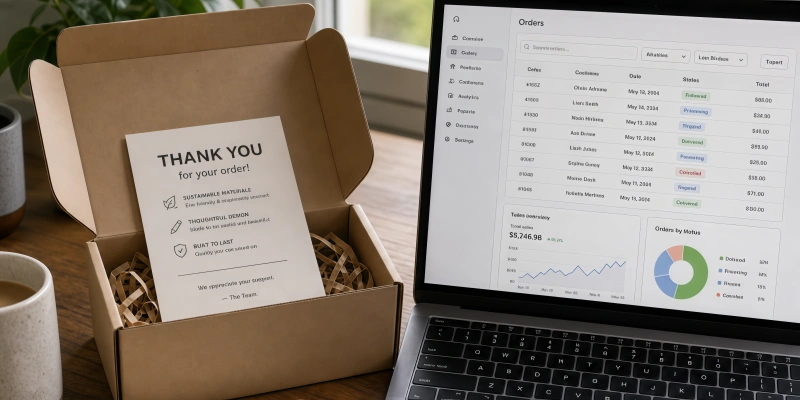
If you offer branded packaging or custom unboxing experiences, document that here. Custom packaging that ships under your brand name is a real differentiator in a category where most stores are indistinguishable from one another.
8. Risk Factors and Mitigation
Most founders skip this section. Most experienced investors and suppliers add credibility points when they see it.
List your top three to five operational risks and your mitigation for each. Common ones for dropshipping in 2026:
- Supplier disruption: Mitigated by using a fulfillment partner with warehoused inventory rather than direct manufacturer shipping
- Shipping delays: Mitigated by local fulfillment nodes for key markets and AI-powered alerts that flag issues before customers report them
- Payment processor holds: Mitigated by low chargeback rates, clear return policies, and documented QC processes
- Platform dependency: Mitigated by building an email list and diversifying traffic channels
Writing this section shows you have thought through the business, not just the upside.
What to Cut
Generic mission statements. Market size statistics that do not connect to your specific niche. Competitor analysis that lists Amazon as a competitor. Org charts for a team of one. Five-year projections with no stated assumptions.
These sections consume time and add no signal for the people reviewing your plan. Cut them or reduce them to a single paragraph.
Putting the Plan Together
The sequence that works: start with your unit economics, build the operations section around your actual fulfillment infrastructure, then write the executive summary last once you know what the plan actually says.
Done this way, a solid plan takes two to three focused days. It will hold up under supplier review, pass payment processor scrutiny, and give an investor enough to make a real decision.
If you are still evaluating your fulfillment setup before writing the infrastructure section, reviewing how dropshipping fulfillment is priced on a per-order versus monthly subscription basis at fulfillment pricing is a useful starting point for building out your cost structure.
Conclusion
The business plans that pass supplier and investor reviews in 2026 are operational documents, not brand decks. Write the unit economics first. Document your fulfillment chain honestly. Cut the sections nobody reads.
If your fulfillment infrastructure is not yet solid enough to write about confidently, that is the first thing to fix — before you write a single word of the plan.
FAQs
What do suppliers actually look for in a dropshipping business plan?
Suppliers primarily want to see that you have a real store, a defined product category, and a process for handling returns and quality issues. They are less interested in your mission statement and more interested in whether you will be a reliable, consistent order source.
Do payment processors review business plans for dropshipping stores?
Some do, particularly when you apply for a merchant account or when your account gets flagged for review. They focus on chargeback exposure, your return policy, and whether your fulfillment model includes a QC layer. Having these documented in a business plan helps if you are ever asked to justify your operations.
How long should a dropshipping business plan be?
For supplier and investor reviews, 8 to 12 pages is usually sufficient. Longer plans are not more credible. Specificity matters more than length.
Do I need a business plan to start dropshipping?
Not to launch. But if you plan to approach suppliers for better pricing, apply for a business bank account, or pitch any form of outside investment, a concise plan covering unit economics and fulfillment infrastructure is worth having.
What financial projections should I include?
A 12-month revenue and margin model with clearly stated assumptions. Include your gross margin per order, estimated customer acquisition cost, and projected chargeback rate. Avoid five-year projections unless specifically requested.
How do I document my fulfillment infrastructure if I use a third-party platform?
Name the platform, describe what it handles — sourcing, QC, warehousing, last-mile — and note the countries it ships to. If the platform provides automated order processing and multi-stage inspection, say so explicitly. That detail matters to payment processors and investors evaluating your operational risk.
Should I include a competitor analysis?
A brief one, yes. Focus on your direct niche competitors, not Amazon or Walmart. Explain specifically why your store serves a segment that existing options do not serve well. Keep it to one page.
References
[1] Zendrop — Per-order and subscription pricing models — zendrop.com/pricing
[2] Spocket — Per-order and subscription pricing models — spocket.co/pricing
[3] Visa and Mastercard — Published merchant guidelines on chargeback thresholds — visa.com / mastercard.com