EU €3 Customs Duty in 2026: A Complete Guide for Shopify Dropshipping Sellers
The European Union is introducing a major customs change that will affect nearly every cross-border ecommerce seller shipping goods into Europe.
Starting July 1, 2026, the EU will remove the long-standing customs duty exemption for imported parcels valued under €150 and introduce a temporary €3 customs duty per HS code classification for eligible low-value imports. This transition period is expected to remain in effect until July 1, 2028. [1]
For many Shopify sellers, this creates new concerns about margins, pricing, fulfillment, and customer experience.
The good news is that the new rule does not mean every parcel will suddenly become unprofitable.
With the right sourcing strategy, accurate product classification, and optimized fulfillment model, sellers can continue growing in Europe while maintaining healthy margins.
In this guide, we'll explain how the new EU €3 customs duty works, why HS code classification matters, and what Shopify sellers can do to reduce costs while staying compliant.
At a Glance
| Key Information |
Details |
| Effective Date |
July 1, 2026 |
| Applies To |
Imported parcels valued at €150 or less |
| Duty Amount |
€3 per HS Code classification |
| Previous Rule |
Duty-free threshold under €150 |
| Temporary Period |
July 2026 – July 2028 |
| Affected Sellers |
Dropshippers, ecommerce brands, Shopify stores, marketplace sellers |
| Main Challenge |
Increased landed costs and customs complexity |
| Best Solution |
Product optimization, accurate declarations, EU fulfillment, smart sourcing |
What Is the EU's New €3 Customs Duty?
The EU's customs reform removes the previous duty exemption for low-value imports.
Under the new system, qualifying imports entering the European Union will incur a flat customs duty of €3 per HS code classification, rather than per parcel. [2]
Many sellers mistakenly believe this means every package receives a single €3 charge.
That is not how the system works.
The customs fee is generally based on the number of declared product categories or HS codes within the shipment.
This distinction is extremely important for dropshipping businesses.
For sellers offering multiple product types in a single order, customs costs can increase significantly if products fall under different classifications.
The reform is part of the EU Customs Reform Package, designed to modernize customs procedures and address the rapid growth of cross-border ecommerce imports.[3]
Understanding HS Codes: Why They Matter More Than Ever
An HS Code (Harmonized System Code) is an internationally standardized system used by customs authorities to classify products. [4]
Under the new EU rule:
- One HS Code = €3 duty
- Two HS Codes = €6 duty
- Three HS Codes = €9 duty
The temporary flat-rate duty model is intended to simplify customs collection while ensuring low-value imports contribute to customs administration costs.[5]
Example 1: Single Product Category
A customer orders:
All products share the same HS Code.
Customs Duty:
€3 Total
Example 2: Multiple Product Categories
A customer orders:
- 1 Phone Case
- 1 LED Desk Lamp
Different HS Codes apply.
Customs Duty:
€6 Total
Example 3: Multi-Category Bundle
A customer orders:
- Phone Case
- Bluetooth Speaker
- Laptop Stand
Three different HS classifications.
Customs Duty:
€9 Total
This is why sellers must pay closer attention to product sourcing, product bundling, and customs declarations than ever before.
How Will the EU €3 Customs Duty Impact Shopify Dropshipping Profit Margins?
For many stores, yes.
According to industry analyses of the EU customs reform, low-ticket ecommerce products are expected to experience the largest proportional margin impact from the new fee structure.[6]
The biggest impact will be felt by:
- Low-ticket products
- High-volume impulse purchases
- Multi-category bundles
- General stores with large SKU catalogs
For example:
| Product Price |
Previous Customs Duty |
New Customs Duty |
| €12 Product |
€0 |
€3 |
| €20 Product |
€0 |
€3 |
| €30 Product |
€0 |
€3 |
A €3 increase on a €15 product represents a much larger margin reduction than on a €60 product.
This means sellers should carefully review:
- Product pricing
- Average order value
- Shipping costs
- Product selection
- EU fulfillment strategy
Many successful brands are already shifting toward higher-margin products and optimized supply chains to offset the new costs.
Why Accurate Product Classification Is Critical
One of the biggest risks under the new system is incorrect product classification.
Incorrect declarations can lead to:
- Customs delays
- Additional inspections
- Unexpected charges
- Shipment holds
- Poor customer experience
As customs authorities increase scrutiny of low-value ecommerce imports, sellers need accurate HS code management and supplier compliance documentation.
This is where choosing the right fulfillment partner with ai alerts becomes crucial.
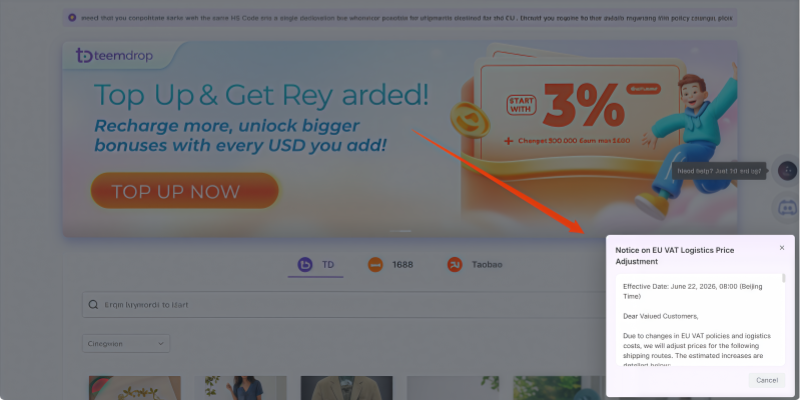
How TeemDrop Helps Shopify Sellers Navigate the EU €3 Customs Duty
Unlike traditional dropshipping platforms that focus only on product imports, TeemDrop provides a complete sourcing and fulfillment ecosystem designed for long-term ecommerce growth.
1. Smart Product Sourcing to Offset EU Customs Costs
TeemDrop helps sellers source products directly from manufacturers and verified suppliers across China.
Benefits include:
- Better supplier transparency
- Lower product costs
- Higher profit margins
- More accurate product data
- Better customs documentation
Reducing sourcing costs becomes even more valuable when new customs fees affect profitability.
2. Accurate Product Data for EU Customs Compliance
The new EU customs framework places greater importance on product declarations.
TeemDrop helps merchants maintain:
- Accurate product descriptions
- Product specification consistency
- Supplier documentation support
- Better customs compliance preparation
Combined with drop shipments, this reduces the risk of customs issues and unexpected clearance delays.
3. EU Fulfillment and Local Warehouse Solutions
For stores with stable European demand, local inventory is becoming increasingly attractive.
Using EU fulfillment services can help sellers:
- Avoid repeated cross-border processing
- Improve delivery times
- Reduce customs complexity
- Increase customer satisfaction
Many large ecommerce brands are already moving toward regional inventory models as part of their European expansion strategy.
4. Automated Order Fulfillment
As customs requirements become more complex, manual processing creates more opportunities for errors.
TeemDrop's automated dropshipping fulfillment system helps merchants:
- Process orders faster
- Reduce operational workload
- Improve accuracy
- Scale efficiently
Automation becomes increasingly important as businesses expand into multiple EU markets.
5. Higher Average Order Value Strategies
One effective way to offset the new customs duty is to increase the average order value.
TeemDrop supports sellers through:
- Product bundling opportunities
- Custom packaging
- Private label services
- Brand-building support
Rather than competing solely on low prices, sellers can create stronger brands and improve overall profitability.
Should You Switch to EU Local Fulfillment?
The answer depends on your business stage.
EU Warehousing Makes Sense If You Have:
- Consistent EU sales
- Predictable inventory demand
- Winning products
- Stable monthly order volume
Direct Dropshipping May Still Be Better If You:
- Test new products frequently
- Sell seasonal products
- Operate a large SKU catalog
- Prefer lower inventory risk
For many Shopify sellers, the best solution is a hybrid approach that combines direct sourcing with strategic dropshipping inventory management across multiple fulfillment locations.
What Ecommerce Sellers Should Do Before July 2026
To prepare for the customs change:
Audit Your Product Catalog
Identify products with:
- Low margins
- Multiple HS code combinations
- Weak profitability
Review Pricing Strategy
Calculate the impact of:
- €3 per HS code duty
- Shipping costs
- VAT obligations
Improve Supplier Data Quality
Ensure suppliers provide:
- Accurate product descriptions
- Consistent classification information
- Compliance documentation
Consider EU Fulfillment
Evaluate whether local inventory could improve both profitability and customer experience.
Final Thoughts
The EU's new customs framework represents one of the most significant changes to European cross-border ecommerce in recent years.
However, this is not the end of dropshipping in Europe.
The sellers who adapt fastest will gain an advantage.
Success will depend on:
- Better product selection
- Accurate HS code management
- Efficient fulfillment
- Strong supplier relationships
- Smarter pricing strategies
With its combination of AI-powered product sourcing, global fulfillment, quality control, automated order processing, and EU fulfillment support, TeemDrop has evolved into a leading ecommerce dropshipping website that helps Shopify sellers navigate these changes while continuing to scale across European markets.
The goal is no longer simply finding products to sell.
The goal is to build a resilient ecommerce operation that remains profitable regardless of regulatory changes.
FAQ
Is the new EU customs duty charged per parcel?
No. The duty is generally charged per HS code classification, not per parcel. A shipment containing multiple product categories may incur multiple €3 charges.
Does the €3 customs duty replace VAT?
No. VAT and customs duties are separate charges. The new €3 fee is a customs duty and does not replace existing VAT obligations.
Will every dropshipping order become more expensive?
Not necessarily. The impact depends on product type, HS code structure, fulfillment method, and overall order value.
Can EU warehouses help reduce customs costs?
For many sellers, yes. Inventory already stored within the EU can reduce reliance on repeated cross-border parcel imports and improve delivery speed.
How can TeemDrop help sellers prepare?
TeemDrop supports merchants through product sourcing, supplier management, quality control, automated fulfillment, and EU warehouse solutions, helping businesses maintain profitability under the new customs rules.
References
[1] European Commission. EU Customs Reform Package
https://taxation-customs.ec.europa.eu/document/download/053e5b4e-f0be-4f20-9a23-3e3b659a6676_en
[2] Nova Analytics. EU €3 Flat Customs Duty Countdown
https://novadata.io/resources/news/eu-3-euro-flat-customs-duty-july-2026-countdown
[3] Council of the European Union. Customs Reform Overview
https://www.consilium.europa.eu
[4] World Customs Organization. What Is the Harmonized System (HS)?
https://www.wcoomd.org/en/topics/nomenclature-overview/what-is-the-harmonized-system.aspx
[5] The Trade Hub. EU Flat-Rate Duty for Low-Value Consignments
https://www.thetradehub.eu/en/news/the-european-union-will-apply-a-flat-rate-duty-of-3-euros-to-low-value-consignments-from-1-july-2026
[6] Reuters. EU to Impose €3 Duty on Small E-commerce Parcels
https://www.reuters.com/world/china/eu-impose-3-euro-duty-small-e-commerce-parcels-july-2026-2025-12-12/