Consumer Trends in 2026: A Practical Guide for Ecommerce Sellers
Online shopping is changing faster than ever. New technology, changing customer expectations, and economic uncertainty are reshaping how people discover, compare, and buy products. For ecommerce businesses, keeping up with consumer trends is no longer optional—it's essential for sustainable growth.
At TeemDrop, we've seen these changes firsthand while helping ecommerce sellers source products, improve fulfillment, and deliver better customer experiences worldwide. The stores that grow the fastest aren't always the ones with the biggest budgets—they're the ones that adapt quickly to changing customer behavior.
According to Shopify, AI-powered shopping and personalized experiences are becoming major drivers of ecommerce growth, while McKinsey reports that AI is changing how consumers research products before making purchasing decisions.[1][2]
This guide covers the biggest consumer trends in 2026, explains why they matter, and shares practical ways ecommerce sellers can respond.
Quick Answer
The biggest trends in consumer behavior in 2026 include AI-assisted shopping, faster delivery expectations, value-focused purchasing, social commerce, personalized shopping experiences, and mobile-first buying. Consumers are spending more time researching products before purchasing, comparing brands across multiple channels, and expecting a smooth shopping experience from start to finish.
For ecommerce sellers, success depends on understanding these consumer purchasing trends and improving product quality, fulfillment speed, customer service, and the online shopping experience. Small changes can make a significant difference in conversion rates and customer loyalty.
At a Glance
| Consumer Trend |
Why It Matters for Sellers |
| AI Shopping |
More customers use AI to research products before buying. |
| Faster Delivery |
Shipping speed influences purchasing decisions. |
| Value-Driven Shopping |
Customers compare quality, price, and reviews—not just cost. |
| Social Commerce |
Product discovery increasingly happens on social platforms. |
| Personalization |
Relevant recommendations improve customer retention. |
| Mobile Shopping |
Most shopping journeys now begin on smartphones. |
Why Consumer Trends Matter for Ecommerce
Consumer trends describe how shopping habits, buying decisions, and customer expectations change over time. Technology, the economy, social media, and new shopping platforms influence these changes.
Today's shoppers have more information than ever before. They compare products across multiple websites, watch video reviews, ask AI assistants for recommendations, and expect fast shipping regardless of where they shop. These consumer buying trends are creating new opportunities—but also new challenges—for online businesses.
For ecommerce sellers, following consumer trend insights helps answer important questions:
- Which products are customers looking for?
- What influences purchasing decisions?
- What shopping experience do buyers expect?
- How can stores stand out from competitors?
Businesses that understand customer behavior trends can make better decisions about sourcing, dropshipping prices, inventory, and fulfillment instead of relying on guesswork.
This is especially important for dropshipping businesses. Since many sellers offer similar products, customer experience often becomes the biggest competitive advantage. Reliable suppliers, quality control, and faster shipping all play an important role in meeting today's expectations.
The following emerging consumer trends are shaping ecommerce in 2026 and are worth paying attention to.

Top 10 Consumer Trends Every Ecommerce Seller Should Watch in 2026
Consumer expectations continue to evolve as technology, shopping habits, and market conditions change. Understanding the latest consumer trends helps businesses make smarter decisions about product selection, marketing, pricing, and fulfillment.
While not every trend will affect every business in the same way, the following trends in consumer behavior are shaping how people discover, evaluate, and purchase products online. Whether you're running a new dropshipping store or managing a growing ecommerce brand, these insights can help you better meet customer expectations and stay competitive in 2026.
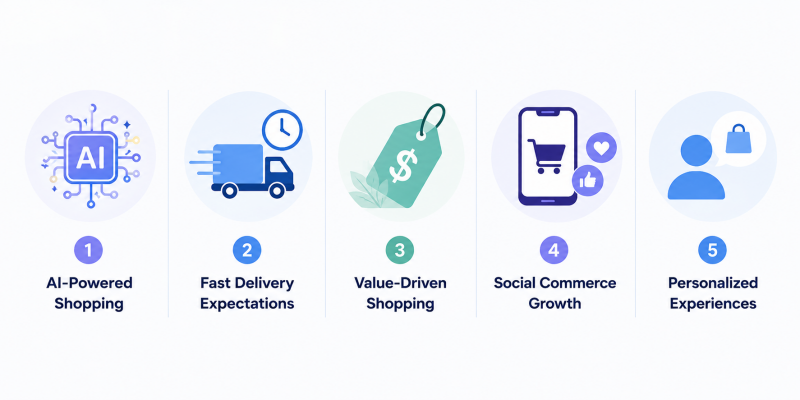
1. AI Is Transforming Consumer Shopping Trends
Artificial intelligence is changing how consumers discover products. Instead of only searching on Google or marketplaces, shoppers increasingly use AI assistants to compare products, summarize reviews, and recommend options based on their needs.
Recent research shows AI-driven shopping is becoming a regular part of the buying process, encouraging retailers to optimize product information for AI-powered discovery.[1]
Why it matters
If product descriptions are incomplete or difficult to understand, AI tools are less likely to recommend them. Clear product information, detailed specifications, and trustworthy customer reviews are becoming even more valuable.
Seller takeaway
Create accurate product listings with clear descriptions, real product images, and transparent shipping information. These improvements help both customers and AI-powered search tools better understand your products.
2. Fast Delivery Is No Longer a Bonus
Shipping speed has become one of the biggest purchase factors across ecommerce. Customers are willing to wait for unique products, but they expect reliable delivery estimates and consistent order tracking.
This shift reflects broader consumer shopping trends where convenience is often valued as much as price.
Why it matters
Slow fulfillment can lead to abandoned carts, negative reviews, and fewer repeat purchases. Even excellent products may struggle if delivery expectations aren't met.
Seller takeaway
Work with custom dropshipping suppliers that offer stable fulfillment, multiple shipping options, and quality inspection before orders are shipped. Platforms like TeemDrop help sellers improve delivery reliability through global dropshipping and fulfillment services and supplier management, making it easier to meet modern customer expectations without managing inventory yourself.
3. Customers Want Value, Not Just Low Prices
Price remains important, but today's shoppers look beyond the cheapest option. They compare product quality, shipping costs, customer reviews, return policies, and brand trust before placing an order.
These current trends in consumer behavior show that customers are becoming smarter buyers rather than simply bargain hunters.
Why it matters
Stores competing only on price often struggle with lower profit margins and weaker customer loyalty.
Seller takeaway
Focus on offering better value instead of simply lowering prices by improving your branded dropshipping products and customer experience. High-quality product images, honest descriptions, reliable fulfillment, and responsive customer service help justify your pricing and build long-term trust.
4. Social Commerce Is Changing Consumer Behavior
Social media is no longer just a place for entertainment. Platforms like TikTok, Instagram, and YouTube have become major product discovery channels.
Many shoppers first discover products through short videos before searching online for reviews or visiting a brand's website.
Why it matters
Customers often interact with multiple channels before making a purchase. A product may be discovered on TikTok, researched on Google, and finally purchased through your online store.
Seller takeaway
Create content that demonstrates products in real-life situations. User-generated content, creator partnerships, and authentic product videos often perform better than traditional advertisements because they build trust naturally.
5. Personalized Shopping Builds Customer Loyalty
Customers increasingly expect brands to understand their preferences. Personalized recommendations, relevant email campaigns, and tailored product suggestions create a smoother shopping experience without making customers feel overwhelmed.
These consumer trend insights show that personalization is becoming an expected part of ecommerce rather than a premium feature.
Why it matters
Personalized experiences help customers discover products faster while increasing average order value and repeat purchases.
Seller takeaway
Use customer purchase history, browsing behavior, and product categories to recommend relevant products. At the same time, respect customer privacy and keep your data collection transparent. Personalization works best when it genuinely helps customers make better purchasing decisions rather than simply encouraging them to spend more.
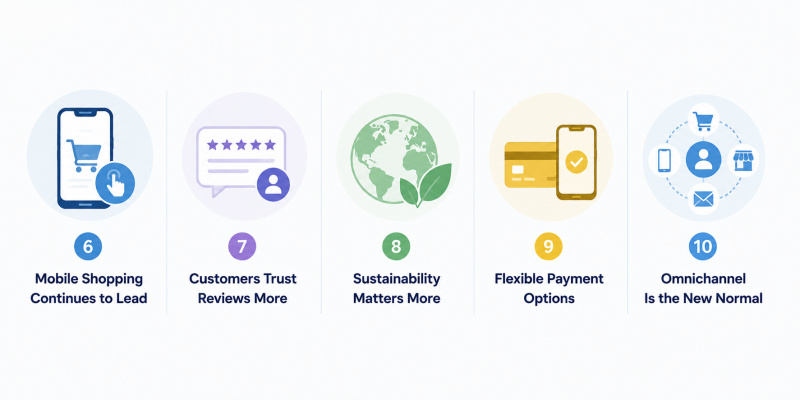
6. Mobile Shopping Continues to Drive Consumer Trends
Shopping no longer starts on a desktop computer. For most consumers, the buying journey begins on a smartphone—whether they're browsing social media, comparing prices, or reading reviews. Mobile commerce continues to grow as shoppers expect fast-loading pages, simple navigation, and secure checkout experiences.[3]
Why it matters
Poor mobile experiences often lead to higher bounce rates and abandoned carts. Even if customers eventually complete their purchase on another device, their first impression is usually formed on mobile.
Seller takeaway
Optimize your store for mobile users by improving page speed, simplifying navigation, and reducing unnecessary checkout steps. Product images should load quickly, buttons should be easy to tap, and payment options should work smoothly across all devices.
7. Customers Trust Reviews More Than Advertisements
Consumers have become more careful before making a purchase. Instead of relying on advertising alone, they look for customer reviews, user-generated content, and real product photos. Positive reviews help reduce uncertainty, especially when customers are buying from a new store.
This is one of the most important consumer buying trends because trust directly affects conversion rates.
Why it matters
Strong social proof builds confidence, while missing or low-quality reviews can discourage potential buyers.
Seller takeaway
Encourage customers to leave honest reviews and showcase authentic product photos whenever possible. Display ratings clearly and respond professionally to customer feedback. Transparency builds credibility over time.
8. Sustainability Continues to Influence Purchasing Decisions
More shoppers want to understand where products come from, how they're packaged, and whether brands operate responsibly. While price and quality still matter, sustainability has become an important factor for many buyers, especially younger consumers.[3]
These consumer goods trends show that shoppers increasingly value transparency alongside product quality.
Why it matters
Customers are paying closer attention to product transparency, sustainability, and brand responsibility. According to the European Commission's Consumer Conditions Scoreboard, trust, product information, and consumer confidence continue to influence purchasing decisions across European markets.[4]
Seller takeaway
You don't need to be a fully sustainable brand overnight. Start with practical improvements such as reducing unnecessary packaging, choosing reliable suppliers, and providing accurate product information. Small changes can strengthen customer trust.
9. Flexible Payment Options Improve Conversion
Modern consumers expect convenient payment methods. Credit cards are no longer the only choice—digital wallets and Buy Now, Pay Later (BNPL) services have become common across many ecommerce markets.
These recent consumer trends reflect growing demand for a faster, more flexible checkout experience.
Why it matters
Limited payment options can create unnecessary friction during checkout and increase cart abandonment.
Seller takeaway
Offer payment methods that match your target market. A simple, secure checkout with trusted payment providers helps improve customer confidence and reduces drop-offs before purchase.
10. Omnichannel Shopping Is Becoming the New Normal
Today's customers rarely shop through a single channel. They may discover a product on TikTok, compare prices on Google, read reviews on YouTube, and complete the purchase on your online store.
These current national consumer and social trends show that the customer journey is becoming more connected across platforms.
Why it matters
Customers expect a consistent experience regardless of where they interact with your brand.
Seller takeaway
Keep your product information, pricing, and branding consistent across your website, social media, marketplaces, and email marketing. A seamless experience makes it easier for customers to move from discovery to purchase.

How Ecommerce Businesses Can Adapt to Consumer Trends
Understanding consumer trends is only the first step. The real opportunity comes from turning these insights into practical improvements that strengthen your business.
Here are six actions every ecommerce seller should prioritize:
- Create clear product pages with complete descriptions and high-quality images that are easy for both shoppers and AI-powered search tools to understand.
- Improve fulfillment speed by working with reliable suppliers and offering accurate delivery estimates.
- Build trust through authentic customer reviews, transparent return policies, and responsive customer support.
- Optimize your website for mobile shoppers with fast-loading speeds and a frictionless checkout.
- Expand your presence across multiple channels, including search engines, social media, and online marketplaces.
- Use customer data responsibly to personalize recommendations and improve the shopping experience.
For dropshipping businesses, operational efficiency is just as important as marketing, especially when using AI dropshipping store tools. At TeemDrop, sellers can simplify sourcing, supplier management, product quality inspection, and global fulfillment from one platform. This allows businesses to respond more quickly to changing customer behavior trends while spending less time managing day-to-day operations.
The most successful ecommerce brands don't chase every new trend. Instead, they focus on the emerging consumer trends that genuinely improve customer experience and build long-term loyalty.
Final Thoughts
Consumer expectations will continue to evolve, but the fundamentals of ecommerce remain the same: customers want quality products, trustworthy brands, and a smooth buying experience.
Rather than trying to follow every new trend, focus on the changes that have the greatest impact on your business. Better sourcing, faster fulfillment, transparent communication, and customer-first experiences are investments that continue to deliver value over time when supported by best dropshipping platforms.
As consumer trend insights continue to shape ecommerce in 2026 and beyond, businesses that stay flexible and put customers first will be in the strongest position to grow.
FAQ
What are consumer trends?
Consumer trends are long-term changes in how people discover, compare, and purchase products. They reflect evolving customer expectations, technology, economic conditions, and lifestyle changes.
Why do consumer trends change?
Consumer behavior changes because of new technology, social media, economic conditions, and shifting lifestyles. Innovations such as AI-powered shopping and mobile commerce continue to reshape how customers make purchasing decisions.
Which consumer trends matter most for ecommerce businesses?
The most important trends in consumer behavior today include AI-assisted shopping, faster delivery expectations, mobile-first shopping, personalization, social commerce, and building trust through customer reviews.
How can online sellers keep up with changing consumer behavior?
Regularly monitor industry reports, analyze customer feedback, review store analytics, and test new strategies. Improving fulfillment, customer experience, and product quality helps businesses adapt to changing consumer purchasing trends more effectively.
References
[1] Shopify. AI Trends Shaping Ecommerce.
https://www.shopify.com/blog/ai-trends
[2] McKinsey & Company. The State of AI.
https://www.mckinsey.com/capabilities/quantumblack/our-insights/the-state-of-ai
[3] OECD. The 2025 Definition of E-commerce and Guidelines for Interpretation.
https://www.oecd.org/en/publications/the-2025-oecd-definition-of-e-commerce-and-guidelines-for-interpretation_2254f1de-en.html
[4] European Commission. Consumer Conditions Scoreboard – Key Consumer Data.
https://commission.europa.eu/strategy-and-policy/policies/consumers/consumer-protection-policy/key-consumer-data_en