SourcingHow to Start Jewelry Dropshipping the Right Way
How to Start Jewelry Dropshipping the Right Way
Jewelry dropshipping in 2026 can be profitable with focused product selection, quality testing, accurate product claims, and reliable fulfillment. Strong supplier control helps reduce returns and support long-term brand growth.
How to Start Jewelry Dropshipping the Right Way
Jewelry can look like an easy dropshipping niche: products are small, highly visual, and easy to add to a store. But the biggest risks are often hidden in the details.
A necklace that looks premium in a supplier photo may arrive with a weak clasp. A ring may have unclear sizing. A "waterproof" finish may not perform as expected. These problems can turn a product with good sales into a product with expensive returns.
TeemDrop can help with sourcing, product checks, and fulfillment, but the first step is understanding what makes a jewelry product worth testing in the first place.
This guide focuses on the decisions that matter most for beginners: choosing products, checking quality, testing samples, calculating costs, and reducing avoidable customer problems.
Quick Answer: Is Jewelry Dropshipping Profitable in 2026?
Yes, jewelry dropshipping can be profitable in 2026, especially for lightweight products with clear customer demand and manageable quality risks.
The key is not finding the cheapest jewelry, but choosing products you can test, price profitably, and fulfill reliably before scaling.
Key Takeaways
Choose a focused jewelry niche and test products before scaling.
Check product quality, sizing, materials, and shipping costs.
Use accurate product information to reduce customer complaints and returns.
Is Jewelry Dropshipping a Good Niche in 2026?
Jewelry has several characteristics that fit the dropshipping model well.
The products are generally small and easy to demonstrate visually. Customers can also buy jewelry for everyday wear, gifts, special occasions, or personal expression. This gives sellers multiple ways to position a collection.
But jewelry also has a trust problem.
Customers cannot fully judge metal quality, finish, weight, or durability from a product photo. That makes accurate product information and sample testing especially important.
Why Jewelry Works Well for Dropshipping
A good jewelry product usually combines three things:
For example, “necklace” is a broad product category.
“Minimalist stainless steel necklace for everyday wear” gives you a much clearer customer, product story, and marketing direction.
Jewelry also works well for bundles. A customer buying a necklace may be interested in matching earrings or a bracelet, creating natural opportunities to increase order value.
What Makes Jewelry Different for Dropshipping?
Unlike clothing, most jewelry does not require complex sizing. Earrings and many necklaces can therefore be easier to test than fitted apparel.
However, jewelry introduces different risks:
Material accuracy
Plating quality
Tarnishing
Broken clasps
Loose stones
Skin-contact concerns
Incorrect dimensions
Poor packaging
This means jewelry supplier quality matters as much as product selection.
Main Jewelry Dropshipping Risks to Consider
Do not assume that a product is safe to sell simply because a supplier describes it as "premium," "waterproof," or "hypoallergenic."
If you sell to U.S. customers, the FTC's Jewelry Guides emphasize truthful representation of a product's type, quality, metallic content, size, weight, durability, origin, and other material characteristics. [1]
Your product page should describe what you can verify—not what sounds most attractive.
Best Jewelry Products to Dropship in 2026
The best products are not necessarily the most viral ones. For beginners, look for products that are easy to explain, test, photograph, and fulfill.
Minimalist Everyday Jewelry
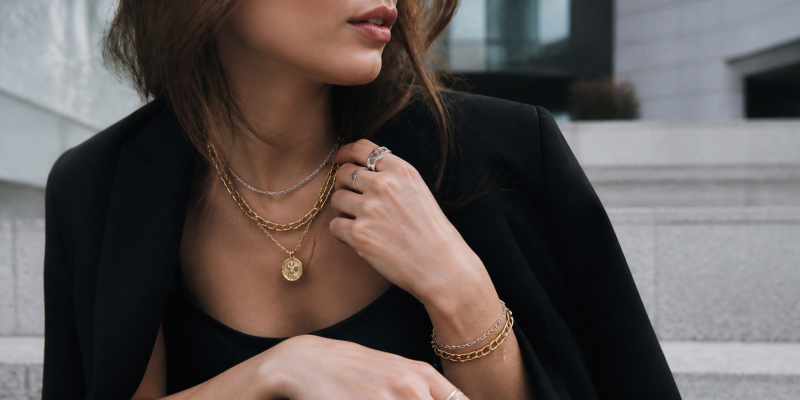
Simple necklaces, small hoops, studs, and basic bracelets can work well because customers can imagine wearing them regularly.
They also make it easier to create a consistent store aesthetic.
Instead of listing dozens of unrelated designs, you could build a collection around:
minimalist + everyday + neutral + easy to layer
This gives the store a clearer identity.
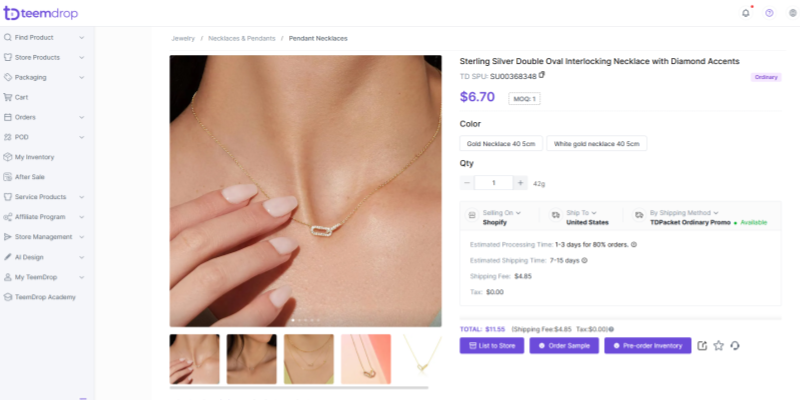
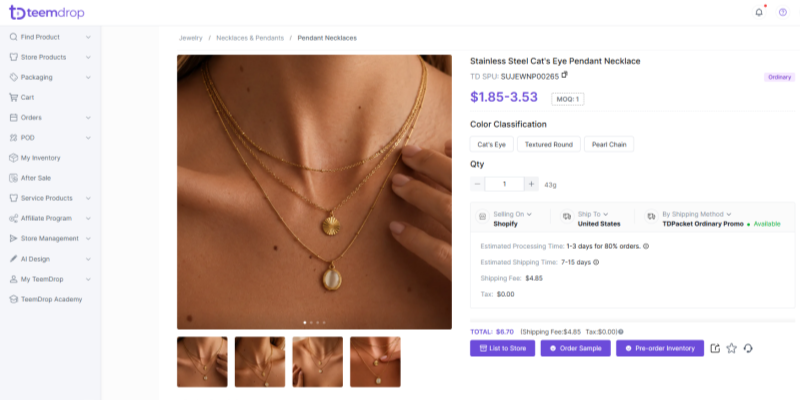
Necklaces and Layered Sets
Necklaces are particularly useful for building collections.
You can sell individual chains, pendants, or coordinated layered sets.
When evaluating them, check:
Chain length
Chain thickness
Clasp strength
Pendant size
Actual material
Weight
A layered set can also make styling easier for customers because the combination has already been selected.
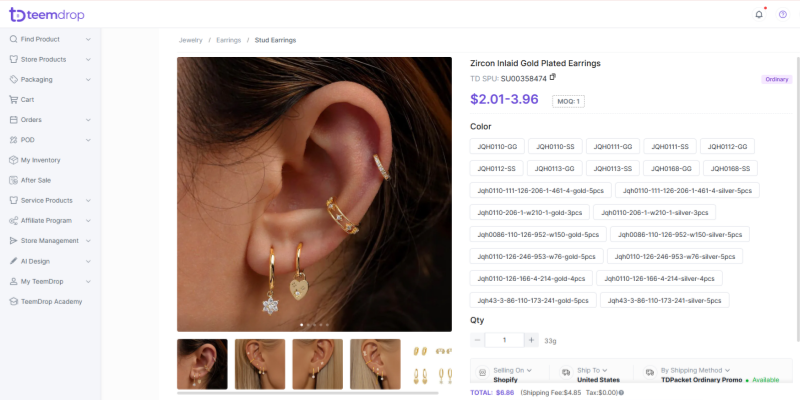
Earrings
Earrings are another beginner-friendly category because they generally do not have the sizing complexity of rings.
Consider:
Studs
Small hoops
Drop earrings
Statement earrings
For larger designs, check the actual weight. Earrings that look attractive in photos can become uncomfortable if they are too heavy.
Rings and Stackable Rings
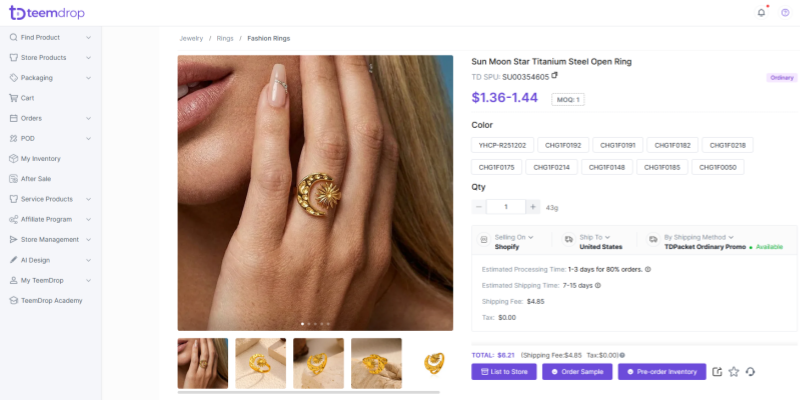
Rings can be attractive products, but sizing creates an additional challenge.
If you sell rings, clearly provide:
Ring size
Diameter or circumference
Measurement method
Available size range
Do not assume customers understand international ring-size conversions.
For beginners, adjustable rings or simple stackable designs may be easier to test than highly specific sizes.
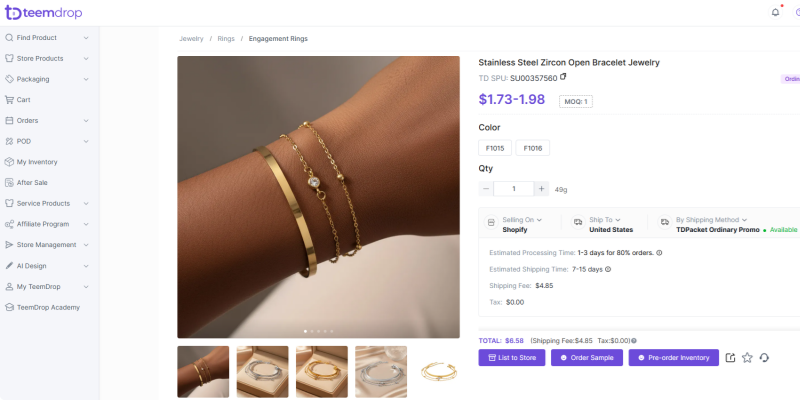
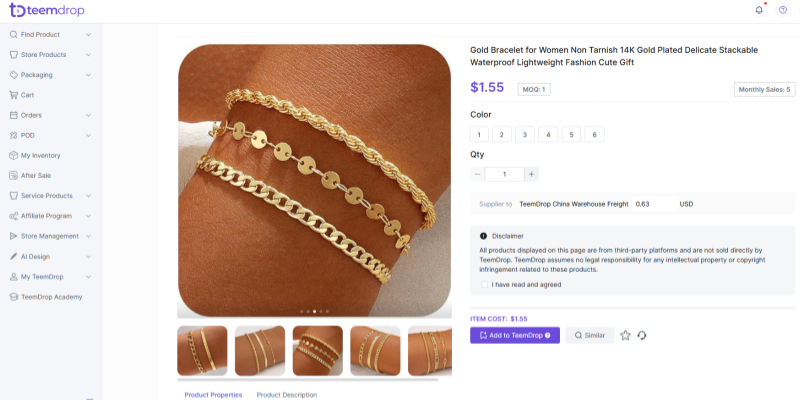
Bracelets
Bracelets can work well as standalone products or as part of matching collections.
Check the bracelet's:
Length
Closure
Material
Adjustability
Weight
Adjustable designs can reduce some sizing friction, but the mechanism itself needs to be tested.
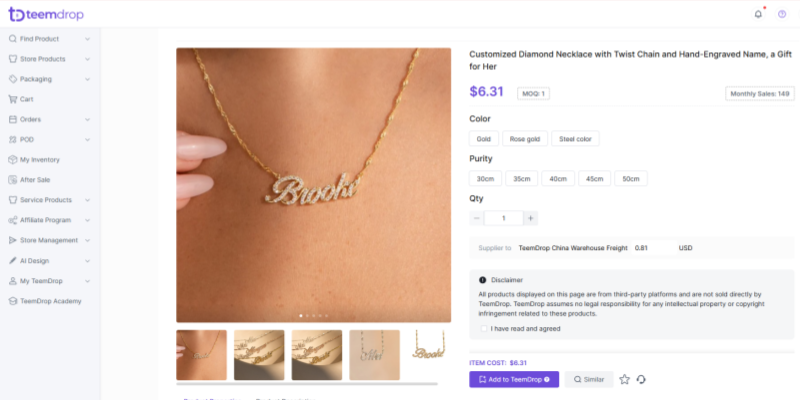
Personalized and Symbolic Jewelry
Initials, birthstones, zodiac signs, and symbolic charms can create stronger emotional connections than generic designs. Sellers interested in personalized jewelry can also consider print on demand jewelry suppliers when evaluating customized product options.
However, personalization introduces an operational issue: order accuracy.
If a customer orders an initial necklace, the wrong letter is not a minor quality issue. It is the wrong product.
Make sure your fulfillment process can correctly handle variants and personalized details before scaling.
Waterproof and Tarnish-Resistant Jewelry
These products solve a practical customer concern and can have strong content potential.
But be careful with the claims.
"Waterproof," "tarnish-resistant," "stainless steel," and similar descriptions should reflect the actual product specifications and testing available from your supplier.
Do not turn a supplier's marketing phrase into a guarantee without verification.
How to Choose Jewelry Products for Dropshipping
Choosing a product should involve more than looking at sales volume.
Check Materials and Product Claims
First identify exactly what the product is made from.
For example:
Stainless steel
Sterling silver
Gold-plated material
Brass
Alloy
Other coated metals
Then check whether the supplier's description matches the actual sample.
This is particularly important because jewelry customers often care about how a product behaves after repeated use.
Evaluate Size and Weight
Small products are not automatically low-risk.
A necklace can have the wrong chain length. A ring can have confusing sizing. An earring can be uncomfortable because of its weight.
Before listing a product, record the actual dimensions and compare them with the supplier's information.
Consider Giftability and Styling
Ask:
Why would someone buy this piece?
Possible answers include:
Everyday wear
Birthday gift
Anniversary
Vacation
Work outfit
Self-gifting
Special occasion
The stronger the use case, the easier it becomes to create product pages and marketing content around it.
For example, a $5 product is not necessarily more profitable than a $10 product if the cheaper item has poor quality and generates more refunds.
Look at Content Potential
Jewelry is highly visual, so ask whether you can demonstrate the product effectively.
Useful content includes:
Try-on videos
Close-up shots
Outfit pairings
Layering demonstrations
Unboxing
Gift ideas
If customers cannot easily understand the product from your content, selling it becomes harder.
How to Test Jewelry Products Before Dropshipping
This is where many beginners can reduce risk before spending money on ads.
Order Samples
Never rely entirely on supplier photos.
Order a sample and inspect the actual product.
Check:
Finish
Color
Weight
Dimensions
Packaging
Clasp
Stones or decorative elements
Overall appearance
A sample costs much less than discovering quality problems after dozens of customer orders.
Check Material and Finish
Compare the sample with the product description.
Does the color match the photos?
Does the finish look consistent?
Are there visible scratches, rough edges, loose parts, or uneven coating?
If the product description makes a material or durability claim, make sure you have enough evidence to support it.
Test Clasps and Moving Parts
Open and close the clasp repeatedly.
Check whether:
It closes securely
The mechanism feels stable
Small parts are loose
Chains pull apart easily
Earrings or pendants stay attached
Small hardware failures can create disproportionate customer complaints.
Check Packaging
Jewelry can be damaged or tangled during shipping.
Test how the item is packed and consider whether the packaging protects:
Chains
Earrings
Stones
Clasps
Delicate finishes
The unboxing experience also affects how customers perceive product value.
Test Product Photography
Your sample is also a content test.
Take photos in natural light and compare them with the supplier's images.
If the product looks substantially different in person, that is a warning sign.
Track Customer Feedback
After launch, do not only track sales.
Watch for repeated comments about:
Tarnishing
Size
Weight
Color
Breakage
Packaging
Shipping
If the same complaint appears repeatedly, investigate the product before increasing ad spend.
How to Start a Jewelry Dropshipping Business
Step 1: Choose a Focused Jewelry Niche
Start with a clear customer rather than a huge catalog.
For example:
Minimalist jewelry for everyday outfits
is easier to build around than:
Jewelry for everyone.
Step 2: Find Products and Suppliers
Compare material information, product specifications, shipping costs, quality, and dropshipping suppliers' consistency.
TeemDrop can be useful when a product is difficult to source or when you need more control over the sourcing and fulfillment process. Its AI dropshipping tools can also support product and supplier evaluation by helping reduce some of the manual work involved in research.
New to TeemDrop? New users can receive a $10 coupon after registration, giving you an easy way to start testing products with a little extra savings. You can use TeemDrop to source products, request samples, and evaluate products before scaling.
Step 3: Order Samples
Test your most promising products before committing significant advertising spend.
Step 4: Build Product Pages
Include:
Accurate material information
Dimensions
Size details
Care instructions
Shipping information
Clear photos
Realistic product descriptions
Step 5: Test a Small Collection
You do not need 100 jewelry products to start.
Test a focused collection and compare performance.
Step 6: Improve Fulfillment and Customer Experience
Once sales begin, fulfillment becomes part of your product quality.
TeemDrop's quality-control process includes pre-shipment inspections, visual proof, defect detection, spot checks, and inspection reports.
For jewelry, this can be particularly useful because small defects may not be obvious until an item is physically inspected.
Step 7: Scale Products That Prove Themselves
Do not scale a product just because it gets clicks.
A product can look excellent when new but perform poorly after use.
Test the actual product and avoid unsupported durability claims.
Sizing and Product Dimensions
Rings, bracelets, and necklaces all require accurate measurements.
Clear information reduces customer confusion.
Breakage and Packaging
Weak clasps, bent posts, and tangled chains can turn inexpensive products into expensive customer-service problems.
Packaging deserves as much attention as the product itself.
Returns and Customer Expectations
A beautiful product photo can create high expectations.
Make sure your photos, descriptions, materials, dimensions, and shipping information accurately represent what customers will receive.
Misleading Product Claims
This is one of the most important risks in jewelry ecommerce.
The FTC states that jewelry marketers should represent products truthfully and disclose material information to consumers. [2]
Do not claim that a product is solid gold, hypoallergenic, waterproof, or made from a specific material unless the claim is properly supported.
Can You Build a Private Label Jewelry Brand With Dropshipping?
Yes.
In fact, dropshipping can be a practical way to test a jewelry concept before investing heavily in inventory or branding.
A sensible progression is:
Test → Validate → Improve → Brand → Scale
First identify products that customers actually buy. Then improve packaging, product presentation, collections, and branding around the products that consistently perform.
This is where a sourcing and fulfillment partner can become more useful than simply finding the cheapest supplier.
TeemDrop supports sourcing, quality checks, fulfillment, and branded dropshipping operations, allowing sellers to build these processes gradually instead of taking on every operational task at once.
Simple necklaces, earrings, bracelets, and some adjustable designs can be easier starting points. The best choice depends on quality, demand, shipping cost, and customer expectations—not just product popularity.
How do I choose a jewelry dropshipping supplier?
Compare material information, product consistency, sample quality, shipping, packaging, fulfillment reliability, and communication. Do not choose based only on the lowest product price.
Should I order jewelry samples before selling?
Yes. A sample allows you to check the actual material, finish, dimensions, durability, packaging, and appearance before customers receive the product.
How can I reduce jewelry dropshipping returns?
Use accurate product information, clear dimensions, realistic photos, tested samples, reliable packaging, and honest material claims. Also monitor customer feedback after launch.
Can I use TeemDrop for jewelry dropshipping?
TeemDrop can support jewelry sellers with product sourcing, quality control, and fulfillment. Its QC process includes inspection and visual verification before shipment, which can help identify product issues before they reach customers.
Final Thoughts
The easiest mistake in dropshipping jewelry is choosing a product because it looks good in a supplier photo.
The better approach is to ask:
Who will buy it? What makes it useful or desirable? What could go wrong? Can I verify the quality? And will the numbers still work after shipping, marketing, and returns?
Start with a focused collection. Order samples. Check materials and dimensions. Test the packaging. Listen to customer feedback. Then scale the products that prove themselves.
That process makes jewelry dropshipping much less about finding a “winning product” and much more about building a product selection customers can trust.
TeemDrop can fit into that process when you need help with sourcing, quality inspection, or fulfillment—but the product should always come first.
More winning products. More sales opportunities. More profits.
Join Teemdrop's VIP community for expert insights, global bestsellers, business roundtables, and exclusive business opportunities to grow your eCommerce profits.