TeemDrop vs Dropship.io: All-in-One Fulfillment vs AI Dropshipping Tool in 2026
Starting a dropshipping business in 2026 is easier than ever. Running one successfully at scale is a different story.
Many sellers can find products. The bigger challenge is managing sourcing, suppliers, shipping, fulfillment, and customer experience without turning operations into a mess.
That is why more ecommerce sellers are now comparing platforms like TeemDrop and Dropship.io.
At first glance, both platforms use AI, and both target dropshipping sellers. But they are built for very different parts of the ecommerce workflow.
Dropship.io mainly focuses on product research, competitor tracking, and ad intelligence. TeemDrop combines AI product discovery with supplier sourcing, warehousing, quality inspection, and global fulfillment.
In other words, one platform helps sellers find products. The other helps sellers build a more complete operational system.
This article compares TeemDrop vs Dropship.io in detail, including features, workflow differences, scaling potential, and which type of seller each platform fits best.
TeemDrop vs Dropship.io: Research Tool vs Fulfillment Platform
The biggest difference between TeemDrop and Dropship.io is not the dashboard or interface.
It is the problem each platform is trying to solve.
What Dropship.io Focuses On
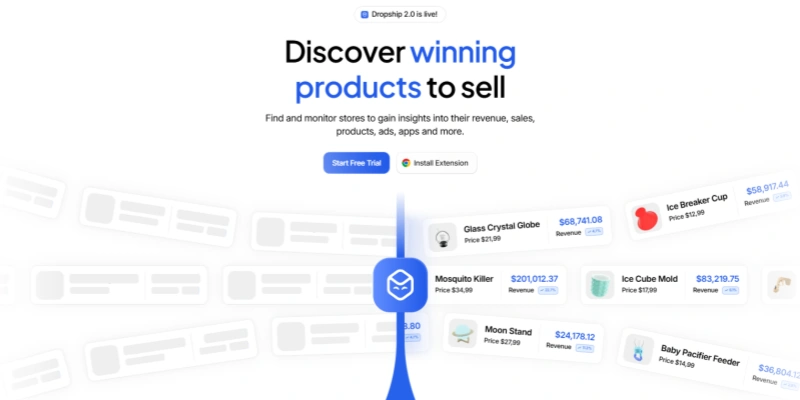
Dropship.io is mainly designed as an AI-powered dropshipping research tool.
Its main features include:
- Product research
- Competitor store tracking
- TikTok and Facebook ad analysis
- Sales estimations
- Shopify store database
- Trend monitoring
The platform is built to help sellers discover products with market potential and analyze what other stores are selling.[1]
For sellers who enjoy testing products aggressively and making data-driven decisions, this kind of software can be useful.
Instead of searching manually through social media platforms every day, sellers can use AI tools and databases to speed up research.
However, Dropship.io is mainly focused on the "research" side of ecommerce operations.
After finding a product, sellers still need to manage:
- suppliers
- sourcing
- quality checks
- inventory
- packaging
- shipping
- fulfillment
through separate tools or external agents.
What TeemDrop Focuses On
TeemDrop takes a different approach.
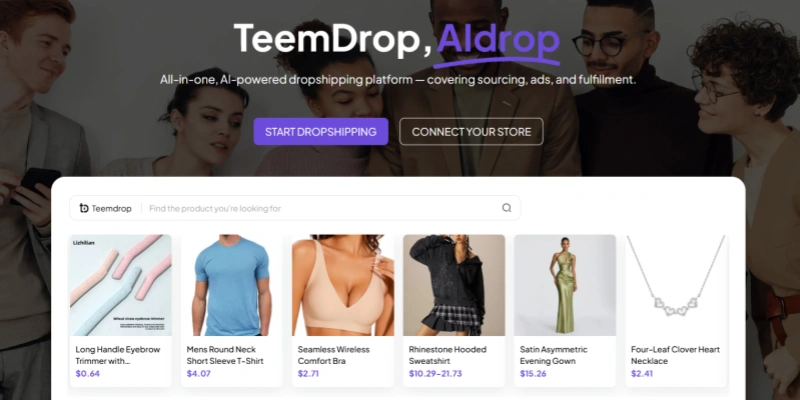
Instead of only helping sellers identify products, TeemDrop combines:
- AI product sourcing
- supplier connection
- procurement
- quality inspection
- warehousing
- order fulfillment
- global shipping
inside one workflow.
This makes TeemDrop less like a standalone AI research tool and more like an all-in-one solution to manage your dropshipping website and its entire backend ecosystem.
For newer sellers, this can simplify operations significantly.
Instead of managing multiple services separately, sellers can handle sourcing and fulfillment from one platform while still using AI to discover products.
This operational focus becomes more important as stores begin scaling.
TeemDrop vs Dropship.io: Feature Comparison
Here is a closer look at how both platforms compare across key areas.
| Feature |
Dropship.io |
TeemDrop |
| Main Role |
AI product research tool |
All-in-one sourcing & fulfillment platform |
| AI Product Discovery |
Yes |
Yes |
| Competitor Tracking |
Yes |
Limited |
| Ad Intelligence |
Strong focus |
Basic trend analysis |
| Supplier Access |
External sourcing required |
Integrated supplier network |
| Product Sourcing |
Manual coordination |
Managed sourcing |
| Quality Inspection |
No |
Yes |
| Warehousing |
No |
Yes |
| Order Fulfillment |
No |
Yes |
| Global Shipping |
External tools required |
Integrated shipping system |
| Branding Support |
Limited |
Available |
| Workflow Style |
Multi-tool setup |
Centralized workflow |
| Best For |
Product testing sellers |
Scaling ecommerce brands |
The table shows that the two platforms are not direct copies of each other.
Dropship.io focuses heavily on market intelligence and product validation.
TeemDrop focuses more on operational efficiency after products are selected.
For many sellers, the real challenge starts after the first successful orders arrive.
TeemDrop vs Dropship.io Workflow Comparison
One of the biggest differences between these platforms appears during daily operations.
Using Dropship.io Often Looks Like This
A common workflow may include:
- Find products through AI research tools
- Search for suppliers manually
- Contact sourcing agents separately
- Negotiate pricing independently
- Manage shipping with another service
- Use tracking software separately
- Coordinate fulfillment manually
This setup gives sellers flexibility.
Some experienced sellers prefer building their own supplier systems and controlling every step independently.
But as order volume increases, operations can become fragmented.
Communication delays between suppliers, agents, warehouses, and shipping tools may create fulfillment problems.
This is especially common for stores scaling through TikTok ads or Shopify campaigns.
Using TeemDrop Often Looks Like This
With TeemDrop, the workflow is more centralized.
A seller can:
- Discover products
- Source directly through the platform
- Manage supplier communication
- Conduct quality inspection
- Store inventory in warehouses
- Fulfill global orders from one system
Instead of connecting several separate tools, the process becomes more streamlined.
For sellers focused on long-term growth, this can reduce operational pressure significantly.
Rather than spending hours coordinating manual tasks, automating your dropshipping fulfillment allows you to spend more time on branding, marketing, content creation, and scaling campaigns.
This is one reason all-in-one dropshipping platforms are becoming more popular in 2026.
Product Research vs Fulfillment: Why Many Sellers Need Both
For beginners, figuring out how can I start dropshipping successfully in 2026, the early focus is usually simple:
Find a winning product.
This is why AI product research tools have become so popular in recent years. Platforms like Dropship.io help sellers identify trending products, monitor competitors, and analyze ads faster than manual research.
In the beginning, this can be extremely valuable.
A strong product can help a new store generate traffic, test audiences, and validate demand quickly.
But once orders start growing, the challenges often change.
Many sellers eventually run into problems such as:
- shipping delays
- inconsistent suppliers
- unstable product quality
- inventory issues
- slower order processing
- customer complaints
At this stage, product discovery is no longer the only priority.
Operations begin affecting:
- profit margins
- customer satisfaction
- refund rates
- repeat purchases
- long-term brand growth
This is one reason many ecommerce sellers eventually move beyond using standalone research tools alone.
Finding products may help launch a store.
But fulfillment systems often determine whether the business can scale sustainably.
That is where integrated platforms like TeemDrop become more relevant.
Instead of separating sourcing, warehousing, supplier communication, and fulfillment across multiple services, sellers can manage these operations in one workflow while still using AI-assisted product discovery.
For growing ecommerce brands, combining product research with stable fulfillment is becoming increasingly important in 2026.
The Hidden Cost of Using Multiple Dropshipping Tools
Many ecommerce sellers underestimate how expensive fragmented operations can become.
A typical seller may use:
- a product research platform
- a sourcing agent
- spreadsheets
- tracking tools
- warehouse software
- communication apps
- shipping platforms
At a small scale, this may seem manageable and heavily dictate how much can you make dropshipping initially, but once order volume increases, operational complexity grows quickly.
Problems may include:
- delayed communication
- inconsistent supplier updates
- inventory confusion
- shipping errors
- slower customer support response times
The issue is not necessarily that any individual tool is bad.
The problem is that too many disconnected systems create friction.
Dropship.io mainly focuses on research and analytics, not fulfillment infrastructure.[1]
TeemDrop’s advantage is that it reduces the number of moving parts sellers need to manage.
For many growing Shopify stores, simplifying operations becomes more valuable than adding more tools.
Which Platform Is Better for Different Sellers?
Both platforms can be useful, depending on business goals and experience level.
Dropship.io May Be Better If You:
- mainly want product research tools
- enjoy testing products manually
- already have trusted suppliers
- focus heavily on ad strategy
- prefer building your own systems
Sellers who already have fulfillment partners may only need stronger market research and trend analysis.
In this case, Dropship.io can work well as an AI product intelligence tool.
TeemDrop May Be Better If You:
- want integrated sourcing and fulfillment
- want fewer operational tools
- need supplier management support
- want faster global shipping
- care about long-term scaling
- want to build a more stable ecommerce brand
For newer sellers, especially, having sourcing, warehousing, fulfillment, and shipping connected inside one platform can simplify growth considerably.
Instead of constantly coordinating separate services, sellers can focus more on building the business itself.
Final Verdict
TeemDrop and Dropship.io are built for different stages of the dropshipping workflow.
Dropship.io is primarily an AI product research and competitor analysis platform. It is useful for sellers who mainly need product data, ad tracking, and market insights.
TeemDrop goes beyond product discovery by combining sourcing, supplier management, warehousing, quality inspection, and fulfillment into one operational system.
For sellers focused only on finding products, a research platform may be enough.
But for sellers looking to scale ecommerce operations with fewer moving parts, integrated fulfillment platforms are becoming increasingly important.
For sellers searching for a Dropship.io alternative with integrated sourcing and fulfillment, TeemDrop offers a more operationally focused workflow.
Finding products can help launch a store.
Building efficient operations is what helps scale one.
FAQ
Is Dropship.io a fulfillment platform?
No. Dropship.io mainly focuses on product research, competitor analysis, and ad intelligence. Sellers still need separate sourcing, warehousing, and fulfillment solutions after selecting products.
What is the main difference between TeemDrop and Dropship.io?
The biggest difference is workflow focus. Dropship.io mainly helps sellers find and analyze products, while TeemDrop combines product sourcing, supplier management, warehousing, and fulfillment into one platform.
Is TeemDrop good for beginners?
Yes. TeemDrop can be helpful for beginners because it reduces the need to manage multiple sourcing and fulfillment tools separately.
Can sellers use both TeemDrop and Dropship.io together?
Yes. Some sellers may use Dropship.io for product research while using TeemDrop for sourcing, warehousing, and fulfillment operations.
References
[1] Dropship.io Help Center — Getting Started
https://help.dropship.io/en/articles/9329212-getting-started-with-dropship-io
[2] Reddit Dropshipping Discussions — Scaling & Fulfillment Challenges
https://www.reddit.com/r/dropshipping/