DropshippingHow Much Can You Make Dropshipping? Real Income & Profit
How Much Can You Make Dropshipping? Real Income & Profit
Dropshipping income varies widely based on product choice, margins, and operations. Consistent profits come from strong suppliers, efficient fulfillment, and reinvesting into ads and brand growth.
How Much Can You Make Dropshipping? Real Income & Profit
The whole "Lambos and Lattes" dropshipping dream you see all over social media — where someone supposedly clicks a few buttons on Shopify and magically wakes up to $10k in their account — is mostly just hype. If you're chasing a get-rich-quick scheme, this isn't it.
But if you're asking whether you can build a legitimate, high-margin business that actually replaces your 9-to-5 income? The answer is a definitive yes.
The math hasn't changed, but the rules of the game have. We are stripping away the fluff to look at the cold, hard numbers of what it actually takes to succeed today.
How Much Can You Make Dropshipping as a Beginner?
The first thing to understand is the massive difference between revenue and profit. You will see "gurus" posting screenshots of $100k months on Twitter. What they conveniently leave out is the $75k spent on Facebook ads and the $15k spent on product costs.
In a healthy dropshipping business, you are usually operating on a 15% to 30% net profit margin. Here is what that looks like across different levels:
The Side Hustler:
Putting in 10-15 hours a week while learning how to start dropshipping, you might see $3,000–$5,000 in revenue, taking home $600–$1,500 in profit.
The Full-Timer:
A solo entrepreneur running one or two winning products can consistently hit $30,000–$50,000 in revenue, netting $6,000–$15,000 in profit.
The Scaled Brand:
At this level, you aren't just dropshipping; you've built a brand. These stores do $100k+ in monthly revenue and see higher margins because they have the volume to negotiate better product prices directly with fulfillment partners.
Is Dropshipping Still Profitable in 2026?
Short answer: yes—but it's more competitive now.
What's changed over the years:
Ads are more expensive
Customers expect faster delivery
Low-quality stores don't convert anymore
What hasn't changed:
People still buy online
Trends still move fast
New products still go viral
According to Shopify: "Dropshipping remains a viable business model, especially for entrepreneurs who focus on branding, customer experience, and reliable suppliers.[1]"
Instead of guessing what dropshippers actually make, it's easier to break it down by experience level. Results vary, but most sellers fall into a few clear income tiers.
Experience Level
Monthly Revenue
Product Cost
Ads & Fees
Estimated Profit
Beginner
$3,000–$8,000
$2,000–$5,500
$500–$1,500
$500–$1,500
Intermediate
$10,000–$30,000
$6,000–$20,000
$2,000–$5,000
$2,000–$8,000
Advanced
$50,000–$150,000+
$30,000–$100,000
$10,000–$25,000
$10,000–$50,000+
Treat these numbers as direction, not guarantees. When you first launch, just breaking even is a massive win while you test ads and fix your store layout. Once you get faster at spotting good products and locking down your shipping, your margins will naturally grow.
The biggest trap is staring at your Shopify dashboard. Huge revenue screenshots look cool, but if your ad costs are too high or your supplier is overcharging you, you are basically working for free. The only metric that actually matters is the cash left in your bank account.
Dropshipping Profit Margin Explained
Most stores operate somewhere between 10% and 30% margins.
To understand your actual take-home pay, you have to track the leakage. If you sell a product for $50, you are not making $50. You are likely keeping about $12 to $15. Here is where the rest goes:
Cost of Goods Sold (COGS): The amount you pay your supplier for the item. This is usually 30-40% of the retail price.
Marketing Costs (CAC): What it costs to acquire a customer via TikTok, Google, or Meta ads. Expect to spend $15–$25 to buy a single conversion.
Platform & Transaction Fees: Shopify subscriptions, app fees, and payment gateways (Stripe/PayPal) take about 3% per swipe.
Operating Costs: This includes returns, software, and eventually, virtual assistants.
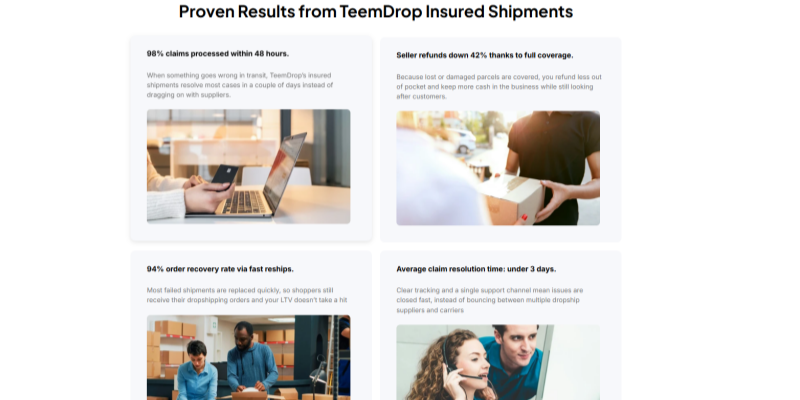
This is exactly where Teemdrop changes the unit economics for store owners. By working with a dedicated fulfillment partner, you lower your COGS through direct factory sourcing. More importantly, you eliminate the massive profit drains caused by high refund rates and shipping delays.
What Affects How Much You Can Make?
There's no single factor—it's usually a combination.
Product Selection
Finding the right dropshipping business products is crucial; some products just don't sell, while others almost sell themselves.
The difference is usually:
Visual appeal (especially for TikTok)
Clear use case
Room for markup
You don't need a "perfect" product, but you do need one that people actually want.
Supplier & Shipping Speed
This is where many stores quietly lose money.
Slow delivery leads to:
Lower conversion rates
More customer complaints
Refunds that eat into your margin
You might still get orders, but you won't keep the profit.
Ad Strategy (Facebook / TikTok)
Ads are where most of your budget goes.
The biggest mistake? Scaling too early.
What works better:
Testing multiple creatives
Keeping budgets controlled at the start
Scaling only what already converts
Store Conversion Rate
You don't need more traffic if your store doesn't convert.
Small improvements here can make a big difference:
Cleaner layout
Better product images
Clear pricing and shipping info
Fulfillment Efficiency
Utilizing professional dropship fulfillment services becomes critical when orders increase, and manual processes start breaking down.
Late shipments, wrong items, tracking issues—it all adds up.
At that point, it's not just about selling anymore. It's about handling volume.
How Long Does It Take to Make Money with Dropshipping?
It usually takes longer than people expect.
A realistic timeline:
Month 1–2 → testing, learning
Month 3–4 → first profitable product (if consistent)
Real Example: How a Dropshipper Makes $10,000/Month
Let's look at a real example with an ergonomic desk accessory:
Retail Price: $45
Product + Shipping (COGS): $14
Ad Spend per Sale (CPA): $18
Processing Fees & Overhead: $3
Net Profit per Unit: $10
To clear $10,000 in actual profit, you need to sell 1,000 units a month. That's roughly 33 sales per day.
And honestly? 33 sales a day is totally doable with one good Google Search campaign or a solid TikTok ad that's hitting right.
Ways to Increase Your Dropshipping Income
Once you are profitable, the goal shifts from "surviving" to "scaling." Here are the main levers you can pull:
Increase Your Average Order Value
Never let a customer check out with just one item. Use post-purchase upsells or "Frequently Bought Together" bundles. If you sell a premium dog bed, offer a dog toy for 50% off at checkout. This turns a $50 customer into a $75 customer with zero added marketing cost.
Improve Conversion Rate & Store Experience
Speed is revenue. If your site takes longer than 3 seconds to load, you are bleeding traffic. Compress your images, use clean, distraction-free themes, and feature authentic customer reviews with photos.
Optimize Your Advertising ROI
Stop spending money on losing ad sets. Use strict rules: if an ad spends 2x your target Cost Per Acquisition (CPA) without a sale, kill it. Take that budget and double down on the creatives that are actually bringing in cheap clicks.
Reduce Costs with Automation & Better Systems
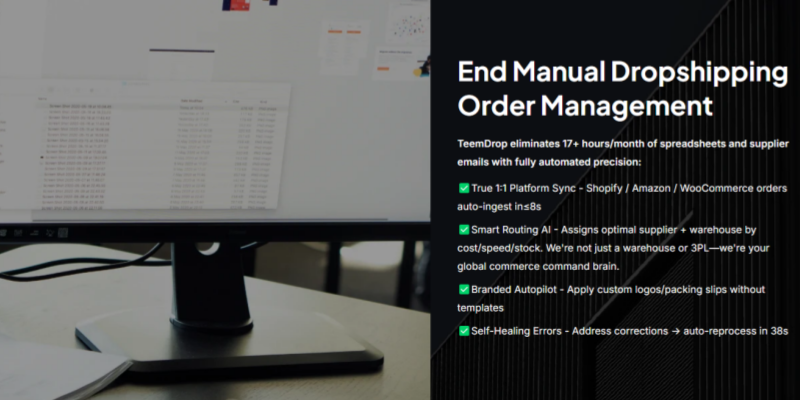
When you hit 10+ orders a day, manually pushing orders to AliExpress will break you. You need a system that syncs automatically. Teemdrop connects directly to your store, automatically processing and fulfilling orders the moment a customer pays. This means you wake up, check your dashboard, and focus purely on marketing while we handle the logistics.
Expand to New Markets
Everyone targets the US market, which makes it expensive. Once you have a winning product, duplicate your campaigns and target the UK, Australia, Canada, or Germany. The ad costs are often cheaper, and the buying power is just as strong.
The Hidden Factor: Your Supplier Determines Your Profit
Most people focus on ads. But what actually determines whether you keep the money is everything happening behind the scenes. As noted by supply chain analysts, e-commerce success today is no longer just about the product itself, but about who has the most efficient, reliable supply chain [2].
How Poor Fulfillment Reduces Profit
If a cheap supplier sends the wrong variant or a defective product, you lose twice. You have to refund the customer, and you eat the cost of the goods. Get enough of these, and payment processors like Stripe will freeze your funds entirely.
Why Faster Shipping Increases Conversion
Trust is the hardest thing to build in e-commerce. When a customer sees a "5-10 Day Tracked Delivery" badge on your product page, their purchase anxiety drops instantly. Fast shipping directly lowers your ad costs because more people are willing to convert.
Supplier Reliability = Scalable Income
Partnering with the best dropshipping suppliers ensures that if you want to scale, your backend can keep up.
That means:
Stable sourcing
Consistent shipping times
Fewer manual processes
This is where a platform like TeemDrop and its dropshipping warehouse network actually make a difference.
Instead of juggling multiple suppliers and dealing with delays, you get:
More stable product sourcing
Faster shipping to major markets
Automated fulfillment that keeps orders moving
It doesn't magically make your store profitable—but it removes a lot of the friction that usually holds people back.
So realistically, dropshipping isn't a fixed-income model.
Some people make nothing.
Some make a few thousand.
A smaller group scales much further.
The difference isn't luck.
It comes down to how well your system works:
Your product
Your ads
Your store
And most importantly — your fulfillment
Because at the end of the day, making money is one thing.
Keeping it is another.
Dropshipping still works.
But only if everything behind it works too.
FAQ
How much do you need to start dropshipping?
At least $500–$1,000. This covers your tools and lets you test a few products with ads.
No money? Check our guide on starting for free with organic social media.
Can you really make $10k/month?
Yes, but $10k profit usually requires $35k–$50k in sales. You'll need good systems and reliable suppliers to make it work smoothly.
Does the supplier matter?
Yes — it’s one of the most important choices. A solid supplier means fewer refunds and happier customers. Cheap but unreliable suppliers usually end up costing you more.
Is dropshipping still worth it for beginners?
Yes. It's tougher than before, but that's good — it filters out the lazy ones. Even if your first store fails, you'll learn valuable skills in marketing, ads, and copywriting.
More winning products. More sales opportunities. More profits.
Join Teemdrop's VIP community for expert insights, global bestsellers, business roundtables, and exclusive business opportunities to grow your eCommerce profits.